
Cost Comparison
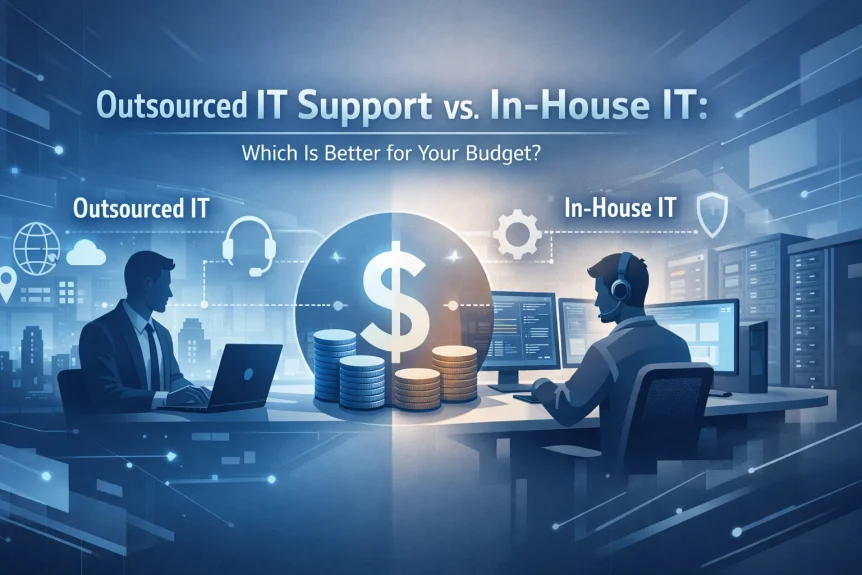
In-house IT for a company with 2–3 staff runs $210,000–$330,000 annually.
Outsourced IT for the same coverage runs $36,000–$96,000 annually.
The difference is 40–70% lower costs with outsourcing.
Break down the in-house numbers:
- Salaries: $160,000–$240,000
- Benefits and payroll taxes: $30,000–$50,000
- Software licenses and tools: $15,000–$30,000
- Training and certifications: $5,000–$10,000
Outsourced providers bundle all services into a flat monthly rate.
Per-Employee Math
In-house support costs approximately $72,700 per seat annually.
This includes labor, technology, compliance work, recruiting costs, and facilities overhead.
Outsourced support costs approximately $28,000 per seat annually.
For a 40-person company, expect around $60,000 total per year with outsourcing. That's $125 per user monthly.
The gap widens as employee count increases.
Hidden In-House Costs
Most internal IT teams operate 8–5, Monday through Friday.
After-hours downtime is unmonitored. Weekend incidents wait until Monday.
Staff turnover averages 35% annually for in-house IT departments.
Outsourced providers see 18% turnover due to distributed workload and career path options.
Single points of failure exist when one person owns critical systems.
Vacation and sick days create coverage gaps.
Knowledge walks out the door when that Windows Server expert leaves.

Compliance mistakes happen more frequently without dedicated teams focused on regulatory requirements.
Project work gets delayed when reactive support takes priority.
Shadow IT proliferates when internal teams lack bandwidth to provision services quickly.
Budget Predictability
Outsourced IT operates on fixed monthly retainers.
Costs are known twelve months in advance.
In-house teams carry variable expenses tied to:
- Salary adjustments
- Recruiting and onboarding
- Project overruns
- Emergency equipment replacements
- Unplanned consulting fees
Seasonal businesses benefit from scaling support up and down without layoffs or hiring delays.

Service Coverage
Outsourced providers deliver 24/7 monitoring and response.
Security events are identified and remediated around the clock.
Backup verification runs automatically with alerts on failures.
Patch management happens during maintenance windows without overtime costs.
In-house teams require additional staff or on-call rotations to match this coverage.
On-call arrangements lead to burnout and quality degradation.
Expertise Depth
Managed service providers maintain teams with specialized knowledge across:
- Microsoft 365 administration
- Network security and firewall management
- Compliance frameworks (HIPAA, SOC 2, CMMC)
- Cloud infrastructure (Azure, AWS)
- Backup and disaster recovery
- VoIP and unified communications
A single in-house technician cannot match this breadth.
Hiring specialists for each domain is cost-prohibitive for organizations under 200 employees.

Technology Stack
Outsourced providers include enterprise-grade tools in monthly fees:
- RMM platforms for monitoring and automation
- PSA systems for ticketing and documentation
- Security stack (EDR, email filtering, SIEM)
- Backup solutions with geo-redundant storage
- Password management and MFA platforms
In-house teams must license these separately.
Annual software costs alone can exceed $15,000–$30,000.
Scalability
Outsourced support adjusts as your company grows or contracts.
Adding 10 employees takes one billing adjustment.
In-house teams require months to recruit, hire, and train additional staff.
Downsizing creates severance obligations and unemployment claims.
When In-House Makes Sense
Organizations where IT is the core product: not a support function: may justify in-house teams.
Software companies building infrastructure products need direct control.
Manufacturers with proprietary industrial control systems require on-site specialists.
For most service businesses, retail operations, and professional services firms, the cost premium doesn't provide commensurate value.
Companies with 65 or fewer employees should default to outsourcing.
Organizations with 65–1,000 employees will likely find outsourcing more cost-effective unless highly specialized requirements exist.
Total Cost of Ownership
Calculate TCO for in-house IT:
- Base salaries × 1.3 (benefits and taxes)
- Software and tools
- Hardware refresh cycles
- Facilities and equipment
- Recruiting and onboarding costs
- Training and certification maintenance
- Turnover and knowledge loss
- Opportunity cost of delayed projects
Compare against:
- Outsourced monthly fee × 12
- Any project work billed separately
The gap consistently favors outsourcing by 40–70%.
Risk Distribution
Outsourced providers carry business continuity risk.
Vendor teams absorb vacation coverage, sick days, and unexpected departures.
SLAs define response times and resolution targets contractually.
In-house teams place full operational risk on your organization.
One technician out sick can halt critical operations.
Decision Framework
Choose outsourcing if:
- Employee count is under 200
- IT is a support function, not your product
- Budget predictability matters
- 24/7 coverage is required
- Compliance obligations exist
- Specialized expertise is needed across multiple domains
Consider in-house if:
- IT is your core product
- On-site presence is mandatory for proprietary systems
- You can justify $200,000+ annual costs for limited coverage
For the majority of small and mid-sized businesses, outsourcing delivers better value, broader expertise, and lower total cost.
The budget difference is measurable. The coverage gap is significant.
We provide managed IT services with transparent pricing and defined SLAs. Contact us for a cost analysis specific to your environment.