Category: blog
Infrastructure Overview
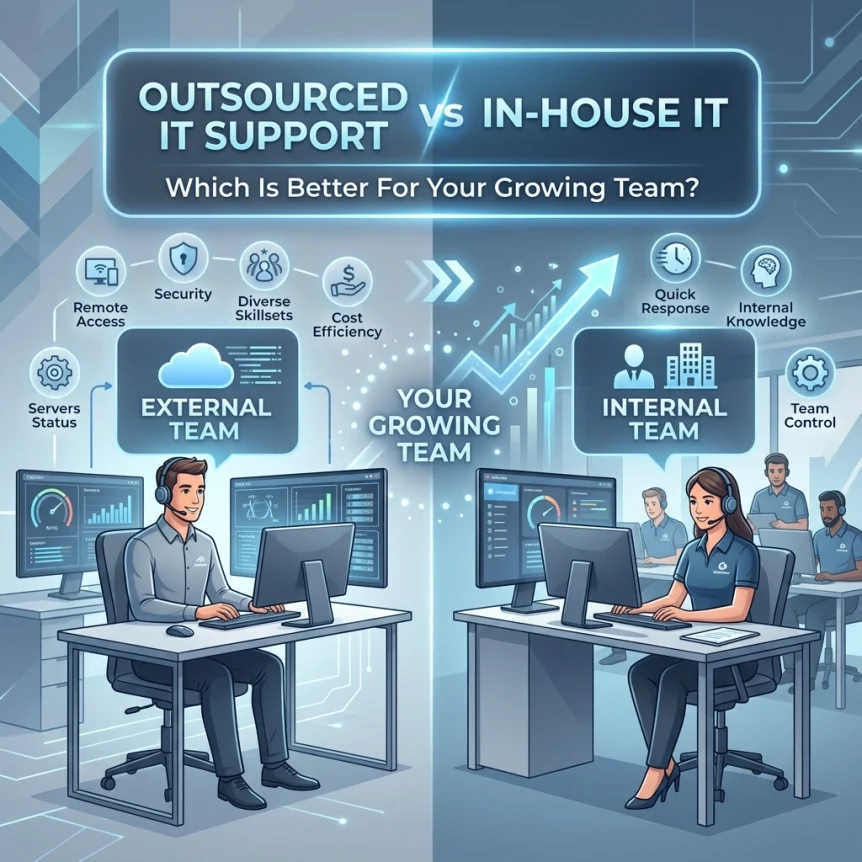
Small to medium-sized businesses face critical infrastructure decisions during growth phases.
Selection of IT management models impacts operational budget and technical resilience.
Comparison between in-house staffing and managed IT services is required for strategic planning.
Technical requirements for scaling teams include network security monitoring and cloud migration.
X-Tek provides professional IT services to address these growth challenges.
Financial Expenditure Analysis
In-house IT staffing requires significant capital and operational investment.
Average annual salary for a qualified IT professional ranges from $70,000 to $120,000.
Additional costs include payroll taxes and employee benefits (estimated 25-35% of base salary).
Recruitment expenses, background checks, and onboarding time must be calculated.
Physical workspace, hardware provisioning, and software licensing add to fixed overhead.
Training and industry certifications are necessary to maintain current technical standards.
Managed IT services operate on a predictable monthly fee structure.
Costs typically range from $1,500 to $4,000 per month for comprehensive support.
Operational budgets remain stable without unexpected hardware or emergency labor spikes.
Training, certification, and staffing redundancies are managed by the provider.
Scaling costs are linear and tied to user counts or service tiers.

Scalability and Response Time
In-house IT capacity is limited by personnel headcount.
Hiring additional staff to meet growth demands requires 45 to 60 days.
Skill gaps occur when internal staff lack specialization in new technologies.
Workloads during expansion can lead to employee burnout and increased turnover.
Emergency coverage is limited by M-F 9AM-5pm Central Time and individual availability.
Outsourced IT provides immediate scalability for growing teams.
Resources are deployed as needed to support new users, locations, and services.
Comprehensive 24/7 support is standard for business-critical operations.
Access to a larger pool of specialized technicians ensures problem resolution across diverse platforms.
Service Level Agreements (SLAs) guarantee response times and system uptime.
https://xtekit.com/uptime
Network Security Monitoring and Risk Management
Cybersecurity threats are evolving and persistent.
Internal teams often focus on day-to-day troubleshooting rather than proactive security.
Network security monitoring requires specialized tools and constant vigilance.
In-house security implementation often lags behind current threat intelligence.
Managed services include dedicated security protocols.
Systems are monitored and remediated continuously to prevent breaches.
Firewalls, antivirus, and endpoint detection are updated automatically.
Security patches are deployed across all workstations and servers systematically.
Vulnerability assessments are performed to identify and mitigate risks.
Disaster recovery plans and offsite backups are maintained to ensure data integrity.
https://xtekit.com/secure

Cloud Migration and Technical Specialization
Internal IT staff are frequently generalists.
Management of complex projects like cloud migration requires specific expertise.
In-house attempts at migration may result in extended downtime or data loss.
Cloud environments must be configured for optimal performance and security.
We facilitate seamless cloud migration for growing SMBs.
Infrastructure is transitioned to scalable cloud platforms with minimal disruption.
Specialized technicians handle complex database and application migrations.
Cloud-based collaboration tools are integrated into existing workflows.
Resource allocation is adjusted in real-time to match business demand.
Communication Infrastructure: VOIP
Legacy phone systems hinder remote work and business expansion.
In-house maintenance of PBX hardware is costly and labor-intensive.
Growing teams require flexible communication solutions across multiple sites.
VOIP (Voice over Internet Protocol) services are implemented to enhance connectivity.
Hardware requirements are reduced through cloud-hosted PBX systems.
Features include unified messaging, mobile integration, and video conferencing.
System updates and feature enhancements are managed externally.
Communication costs are reduced while reliability is improved.

Operational Availability
In-house IT availability is restricted by sick leave, vacations, and standard hours.
Systems remain vulnerable during off-hours unless overtime is authorized.
Critical failures on weekends or holidays result in prolonged downtime.
Outsourced IT ensures continuous operational oversight.
Systems are monitored 365 days a year.
Automated alerts trigger immediate response from on-call engineering teams.
Redundancy in staffing prevents service gaps during personnel absences.
https://xtekit.com/services
The Hybrid Integration Model
Some organizations utilize a hybrid IT structure.
Internal IT managers focus on high-level strategy and internal workflows.
Outsourced providers handle routine maintenance, security, and help desk support.
This model leverages organizational knowledge with external technical depth.
Collaboration between internal and external teams improves overall infrastructure health.

Technical Logistics and Tools
Effective IT management requires a comprehensive suite of tools.
Remote Monitoring and Management (RMM) platforms are deployed.
Professional Services Automation (PSA) systems track service history and hardware lifecycle.
Ticketing systems ensure accountability and historical data for troubleshooting.
Documentation of network architecture is maintained for rapid recovery.
https://xtekit.com/tools
Vendor Management
In-house staff must manage multiple third-party vendors (ISPs, hardware manufacturers, software devs).
Managed IT providers act as a single point of contact for all technical vendors.
Procurement is streamlined through established supply chain relationships.
Warranty claims and hardware replacements are handled by the service provider.
Implementation Summary
Growing businesses require IT that scales without friction.
Managed services provide a higher return on investment for most SMBs.
Security posture is strengthened through professional monitoring and remediation.
Technical debt is reduced through modernized infrastructure like cloud and VOIP.
Operational focus remains on core business growth rather than technical maintenance.

Direct Contact Information
Company: X-Tek
Category: IT Services
Phone: 815-516-8075
Website: https://xtekit.com
Blog: https://xtekit.com/blog
Action Items
Review current IT expenditure and staffing levels.
Assess current network security monitoring capabilities.
Evaluate cloud migration readiness for existing applications.
Determine communication needs for remote or expanding teams.
Have Questions?
https://xtekit.com/business-solutions-information-request/
Service Specifications
- Managed IT Services
- Cloud Migration
- Network Security Monitoring
- VOIP Implementation
- Strategic Technical Consulting
- 24/7 System Oversight
Managed infrastructure remains a requirement for modern business competition.
Decisions regarding IT staffing impact long-term scalability and security.
Professional services ensure that technical growth aligns with business objectives.
We provide the expertise required to navigate these transitions.
Friday, 27 of March 2026
815-516-8075
X-Tek
M-F 9AM-5pm Central Time