
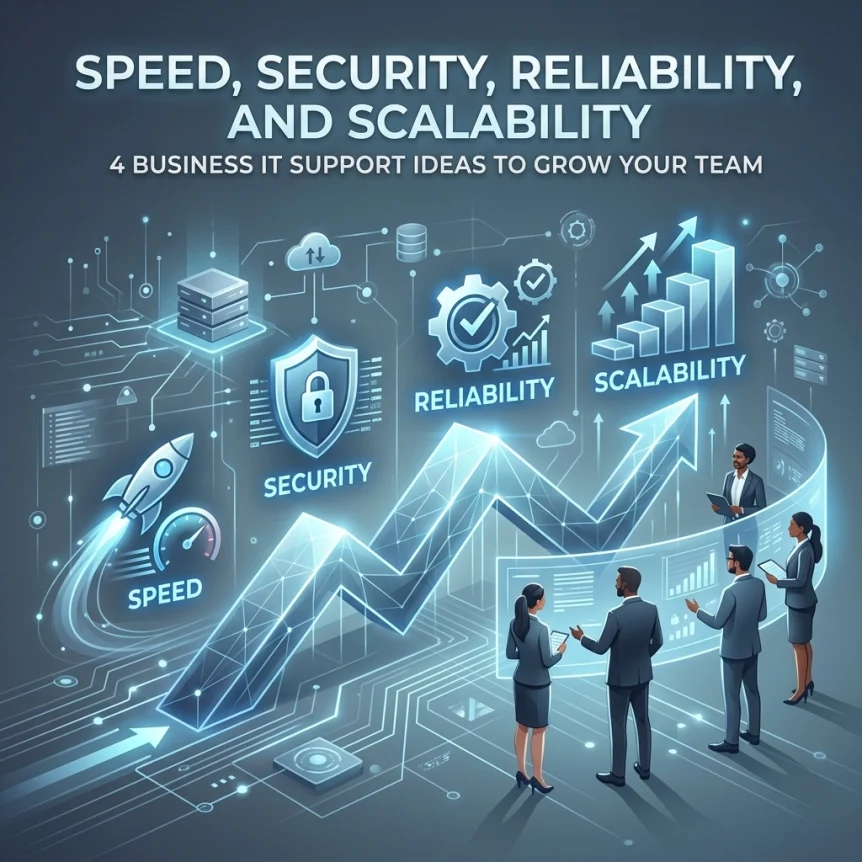
Operational Infrastructure
Standardized IT frameworks for small and medium-sized businesses.
Infrastructure alignment with organizational growth goals.
Systems optimized for workforce expansion.
Speed
Performance metrics define team output.
Low-latency environments required for collaborative software.
Network throughput optimization.
High-bandwidth fiber backhaul implementation.
Low-latency switching environments.
Hardware lifecycle management ensures peak processing power.
VOIP Implementation
Communication systems integrated via Voice over Internet Protocol.
Elimination of legacy copper wire limitations.
Unified communications across remote and on-site locations.
Cloud-hosted PBX systems.
Real-time voice traffic prioritization.
Quality of Service (QoS) tagging on routers.
Reduction in jitter and packet loss.
Rapid onboarding for new personnel extensions.

Network Efficiency
Bottleneck identification through traffic analysis.
Managed IT services address congestion points.
Internal Wi-Fi 6E deployment for high-density environments.
Segregated guest and corporate traffic.
Symmetrical upload and download speeds for cloud synchronization.
Automated load balancing across multiple ISP circuits.
Security
Risk mitigation for expanding digital footprints.
Attack surface reduction during team scaling.
Endpoint protection for distributed workforces.
Network security monitoring.
Proactive Defense
Continuous surveillance of network traffic.
Intrusion Detection Systems (IDS) deployment.
Intrusion Prevention Systems (IPS) automated responses.
Real-time alert logging for suspicious login attempts.
Geofencing protocols for access control.
Security Information and Event Management (SIEM) integration.
Phishing simulation for employee awareness.

Zero Trust Architecture
Identity verification for every access request.
Multi-Factor Authentication (MFA) enforcement across all applications.
Least-privilege access models.
Segmented network zones to contain potential breaches.
Encrypted data transmission for remote team members.
VPN or SASE (Secure Access Service Edge) implementation.
Regular vulnerability assessments and penetration testing.
Reliability
Uptime consistency during peak operational hours.
Business continuity through redundant systems.
Managed IT services oversight.
System health are monitored and remediated.
Maintenance Protocols
Automated patch management for operating systems.
Firmware updates for network hardware.
Proactive disk health monitoring.
Thermal monitoring for server environments.
Uninterrupted Power Supply (UPS) redundancy.
Failover testing for critical applications.
Minimized scheduled downtime through rolling updates.

Data Integrity
Automated backup scheduling.
Off-site data replication.
Immutable backup storage to prevent ransomware encryption.
Disaster Recovery as a Service (DRaaS) implementation.
Recovery Point Objectives (RPO) defined by business needs.
Recovery Time Objectives (RTO) minimized for essential services.
Verified restoration testing conducted monthly.
Scalability
Resource elasticity for fluctuating team sizes.
Cloud-native infrastructure adoption.
Legacy system modernization.
Cloud migration.
Infrastructure Flexibility
Transition from capital expenditure (CapEx) to operational expenditure (OpEx).
On-demand resource provisioning.
Virtual Desktop Infrastructure (VDI) for rapid hardware deployment.
Azure or AWS environment management.
Hybrid cloud configurations for sensitive data residency.
Scalable storage arrays.
Elastic compute power for data-heavy applications.

Software Ecosystems
SaaS (Software as a Service) integration for team collaboration.
Centralized license management.
Automated user provisioning and deprovisioning.
Cross-platform compatibility.
Application Programming Interface (API) connectivity between tools.
Standardized software images for new hires.
Legacy application encapsulation for modern OS compatibility.
Growth Roadmap
Strategic alignment of IT budget with hiring targets.
Forecasting hardware requirements six months in advance.
Standardized workstation configurations.
Documentation of IT procedures for new staff.
Quarterly business reviews of technology performance.
Audit of cloud spending to eliminate waste.
Alignment with industry compliance standards.

Technical Support
Help desk availability for troubleshooting.
Remote assistance for software conflicts.
Hardware repair and replacement cycles.
On-site support for physical infrastructure issues.
Support hours: M-F 9AM-5pm Central Time.
Have Questions?
https://xtekit.com/business-solutions-information-request/
Contact Information
Business Solutions Information Request:
https://xtekit.com/business-solutions-information-request/
Phone: 815-516-8075
Business Hours: Monday – Friday, 9:00 AM – 5:00 PM Central