
Category: blog
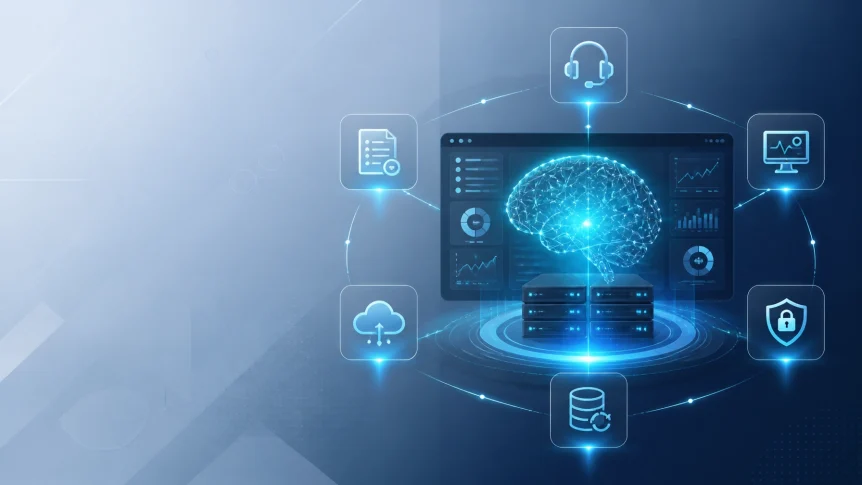
AI-powered IT support is changing managed services.
The focus is moving from ticket response to continuous infrastructure management.
From:
- Manual ticket sorting
- Reactive troubleshooting
- Periodic system checks
- Human-led log review
- Delayed incident response
To:
- Automated classification
- Pattern detection
- Predictive maintenance
- Continuous monitoring
- AI-assisted remediation
- Human oversight for complex decisions
For small and medium-sized businesses, the result is faster support and fewer preventable disruptions.
AI in the IT service desk

Service desk platforms can use AI to process incoming requests.
Common functions include:
- Ticket classification
- Priority assignment
- Duplicate detection
- User verification
- Knowledge-base search
- Suggested troubleshooting steps
- Automated password reset workflows
- Escalation to the correct technician
- Status updates
Routine requests can be handled without waiting for a technician.
Examples:
- Password resets
- Printer configuration
- Software access requests
- Account lockouts
- Basic connectivity issues
- Standard device setup
- Common application errors
Complex requests are routed with relevant information already attached.
Technicians can receive:
- User history
- Device information
- Recent changes
- Related tickets
- Error logs
- Suggested remediation steps
- Known issue matches
Less time is spent collecting information.
More time is available for resolution.
X-Tek managed IT services combine automated service workflows with human technical support. AI assists the process. Technicians remain responsible for exceptions, infrastructure changes, security decisions, and business-impacting incidents.
Faster resolution with better context
Traditional support often begins with incomplete information.
A user reports that “the network is slow.”
The technician then has to determine:
- Which user is affected
- Which device is involved
- Whether the issue is local or widespread
- When the issue began
- What changed recently
- Whether bandwidth is available
- Whether an endpoint is generating abnormal traffic
- Whether a security event is involved
AI-supported tools can correlate these signals before the ticket reaches a technician.
The issue may be linked to:
- A failing network device
- High bandwidth utilization
- A software update
- An overloaded server
- An endpoint configuration problem
- A security policy
- A cloud service interruption
This reduces diagnostic time.
It also improves escalation quality.
The objective is not simply faster replies.
The objective is lower mean time to resolution and lower business impact.
Proactive care replaces avoidable emergencies

AI extends monitoring beyond basic alerts.
Systems can be evaluated for patterns that indicate future problems.
Examples:
- Storage capacity approaching a defined threshold
- Repeated endpoint crashes
- Increasing network latency
- Backup jobs showing abnormal duration
- Hardware reporting escalating errors
- Authentication attempts outside normal patterns
- Servers operating under sustained load
- Devices missing required patches
- Applications producing repeated failures
A single alert may not indicate an incident.
A pattern may.
AI can compare current behavior with historical baselines and related system activity.
When a risk is identified:
- An alert is generated
- A ticket can be opened
- The issue is assigned
- Remediation steps are recommended
- A technician reviews the event
- Approved actions may be automated
- The outcome is recorded
Problems are addressed before users report them where possible.
This is the core distinction between break-fix support and managed IT services.
Managed IT services from X-Tek include monitoring, maintenance, cybersecurity, backup, help desk support, and infrastructure planning.
AI and cybersecurity operations

Security teams work with large volumes of data.
Logs are generated by:
- Firewalls
- Endpoints
- Email systems
- Identity platforms
- Cloud applications
- Servers
- Network devices
- Backup systems
- Remote access tools
AI can correlate these events.
It can identify activity that may be missed when systems are reviewed separately.
Potential indicators include:
- Repeated failed logins
- Impossible travel patterns
- Unusual file access
- Malware behavior
- Unauthorized privilege changes
- Suspicious email activity
- New application connections
- Abnormal data transfers
- Disabled security controls
AI can support:
- Threat detection
- Alert prioritization
- User and entity behavior analysis
- Endpoint response
- Phishing analysis
- Vulnerability prioritization
- Incident documentation
- Containment workflows
Automation must remain controlled.
Security actions can affect users, data, and business operations.
High-impact changes should require authorization.
Human review remains necessary for:
- Account suspension
- Network isolation
- Data deletion
- Firewall policy changes
- Privilege changes
- Incident notification
- Recovery decisions
X-Tek manages cybersecurity as part of the wider IT environment.
Network security planning for AI-powered attacks should include identity controls, endpoint protection, monitoring, policy review, backup, and response procedures.
Backup monitoring and recovery readiness
AI support also applies to backup operations.
A completed backup job does not always mean that recovery is possible.
Monitoring can evaluate:
- Backup completion
- Backup duration
- File and system changes
- Storage consumption
- Replication status
- Failed agents
- Encryption status
- Retention compliance
- Recovery point objectives
- Restoration test results
Unusual backup behavior may indicate:
- A configuration problem
- A storage issue
- A disconnected device
- A ransomware event
- A permissions change
- A failed replication process
Alerts can be escalated before the next recovery requirement.
Backup systems should be reviewed with the same priority as production systems.
Business continuity depends on:
- Multiple recovery points
- Separate backup copies
- Access controls
- Documented procedures
- Recovery testing
- Defined recovery time objectives
- Ongoing monitoring
X-Tek provides backup and business continuity support as part of a managed infrastructure strategy.
Cloud and endpoint management
AI-supported tools can improve cloud administration and endpoint maintenance.
For cloud environments, monitoring can identify:
- Unused resources
- Access anomalies
- Configuration drift
- Capacity changes
- Failed synchronization
- Policy violations
- Service dependencies
- Unusual usage patterns
For endpoints, the same approach can support:
- Patch compliance
- Device health
- Application failures
- Encryption status
- Malware activity
- Performance issues
- Hardware lifecycle planning
- Configuration consistency
The result is a more complete view of the environment.
Users, applications, devices, servers, cloud services, and security events are evaluated together.
This is important for organizations using Microsoft or Google cloud services, remote work platforms, hosted applications, and mixed on-premises infrastructure.
Cloud migration planning should include monitoring, identity, backup, security, and support requirements from the beginning.
What AI does not replace
AI is not a replacement for an experienced managed service provider.
AI cannot independently understand every business requirement.
It may not know:
- Which systems are mission critical
- Which downtime is acceptable
- Which users require special access
- Which vendors support a specific workflow
- Which compliance requirements apply
- Which business change is planned
- Which remediation creates operational risk
Human expertise remains necessary for:
- Network design
- Cloud architecture
- Vendor coordination
- Disaster recovery planning
- Security governance
- Technology roadmaps
- Complex troubleshooting
- Compliance planning
- Infrastructure changes

The effective model is human and AI collaboration.
AI handles volume, correlation, repetition, and pattern analysis.
IT professionals handle judgment, planning, communication, and accountability.
Questions to ask an IT provider
AI capabilities should be evaluated as part of the complete managed service.
Ask:
- Which monitoring systems use AI or machine learning
- What actions are automated
- Which actions require approval
- How are false positives handled
- How are tickets prioritized
- How are backup failures escalated
- How are endpoints monitored outside business hours
- How are security alerts correlated
- How is customer data protected
- How are AI tools governed
- Which service metrics are reported
- How are recommendations documented
- How is human oversight maintained
Avoid vague claims.
Request operational details.
Useful metrics include:
- Mean time to acknowledge
- Mean time to resolve
- Preventive maintenance completion
- Patch compliance
- Backup success rate
- Recovery test results
- Security alert response time
- Ticket recurrence
- Endpoint health
- Network availability
The provider should explain how AI supports these outcomes.
What this means for your business
AI-powered IT support changes the expected role of managed services.
The provider is not only responding to issues.
The provider is expected to:
- Identify risk earlier
- Reduce repetitive work
- Improve response speed
- Protect business systems
- Monitor backup operations
- Support cloud environments
- Maintain endpoint standards
- Document infrastructure changes
- Provide measurable service data
X-Tek uses managed IT processes to support business continuity, infrastructure maintenance, security monitoring, cloud services, and technical support.
AI can improve the speed and consistency of those processes.
It does not remove the need for accountable IT professionals.
The practical standard is clear:
- Faster resolution
- Earlier detection
- Fewer preventable outages
- Better security visibility
- Verified backup operations
- Controlled automation
- Human oversight
Businesses evaluating managed IT services should include AI readiness in the selection process.
Technology changes quickly.
The support model must keep pace.
Contact Information
Business Solutions Information Request:
https://xtekit.com/business-solutions-information-request/
815-516-8075