
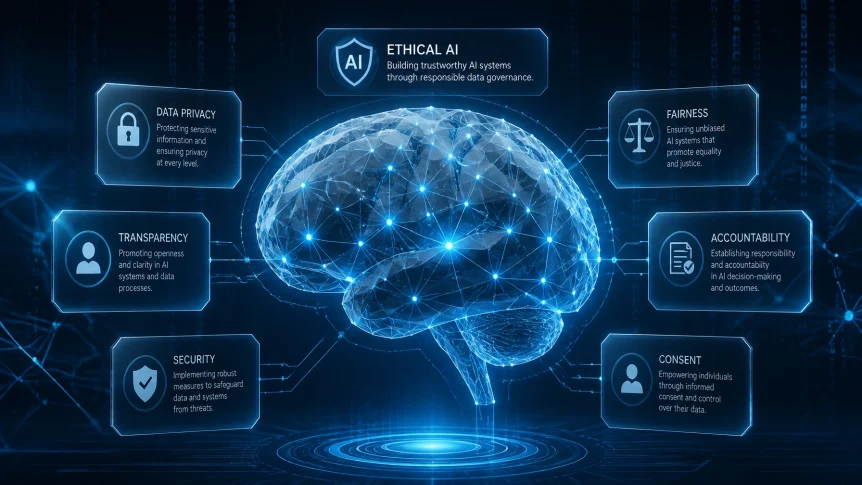
Landscape
AI adoption in 2026.
Small business integration increasing.
Complexity of data management.
Legal risks.
Reputational risks.
Operational efficiency vs ethical standards.
Small businesses as targets for compliance audits.
Need for structured frameworks.
Principles
Transparency.
Clear communication of AI usage.
Notification to end-users.
Staff awareness of internal tools.
Disclosure of automated decision-making.
Explainability of AI outputs.
Fairness.
Bias detection in algorithms.
Avoidance of discriminatory outcomes.
Neutrality in data selection.
Representative training sets.
Periodic review of high-impact decisions.
Accountability.
Designated oversight.
Human-in-the-loop requirements.
Error correction protocols.
Liability for AI-generated content.
Responsibility for data breaches.
Privacy.
Data protection by design.
Minimal data footprint.
Consent management.
Encryption of processed sets.
Secure deletion policies.
Ownership
Appointment of AI/Data Lead.
Coordination of IT and management.
Policy development.
Vendor vetting.
Employee training oversight.
Cross-functional review group.
Operations input.
Legal/Compliance input.
Technical IT support.
Quarterly assessment meetings.
Incident response planning.
Data
Inventory.
Classification of all data assets.
Mapping of data flow to AI tools.
Categorization: Public, Confidential, Highly Sensitive.
Source documentation.
Usage logs.
Quality standards.
Validation of input sets.
Removal of duplicates.
Anonymization of PII.
Accuracy checks for generated outputs.
Consistency in data formatting.
Minimization.
Collection limited to defined purpose.
Shortened retention periods.
Automatic pruning of legacy data.
Reduction of redundant storage.
Avoidance of over-scoped scraping.

Governance
Documentation.
Version control for AI policies.
Data processing agreements (DPAs).
Impact assessments.
Audit trails for automated actions.
Centralized register of AI tools.
Lifecycle management.
Decommissioning of obsolete models.
Archival of training data.
Continuous performance monitoring.
Feedback loops for data drift.
Update schedules for governance frameworks.
Security
Access controls.
Role-based permissions (RBAC).
Multi-factor authentication (MFA) for AI consoles.
Zero-trust architecture.
Privileged access management.
Activity logging.
Encryption.
Data encrypted at rest.
Data encrypted in transit.
Secure API connections.
Hardware security modules for key management.
End-to-end encryption for client communications.
Monitoring.
24/7 security scans.
Anomaly detection in AI behavior.
Automated threat remediation.
Log aggregation and analysis.
Uptime monitoring for critical services: https://xtekit.com/uptime

Vendors
Due diligence.
Security certification verification (SOC 2, ISO 27001).
Data usage terms review.
Opt-out of model training.
Geographic data residency checks.
Contractual liability clauses.
Third-party risk management.
Supply chain vulnerability scans.
Service level agreement (SLA) enforcement.
Regular vendor performance audits.
Transition plans for vendor exit.
Bias
Identification.
Sample testing of AI outputs.
Demographic parity checks.
Identifying historical bias in training sets.
External benchmarking.
Remediation.
Adjusting data weights.
Supplementing underrepresented data.
Manual override protocols.
Algorithm refinement.
Transparency reports for stakeholders.

Compliance
Regulatory mapping.
GDPR (General Data Protection Regulation).
CCPA/CPRA (California Privacy Rights Act).
State-level AI acts.
Industry-specific mandates (HIPAA, FINRA).
Documentation for legal defense.
Impact assessments.
Data protection impact assessment (DPIA).
Algorithmic impact assessment (AIA).
Risk categorization: Low, Medium, High.
Mitigation strategy documentation.
Evidence of diligence.
Operations
Employee training.
Acceptable use policies.
Data handling procedures.
Prompt engineering safety.
Phishing awareness for AI-generated attacks.
Reporting procedures for ethical concerns.
Managed IT integration.
Continuous infrastructure maintenance.
Cloud services security: https://xtekit.com/secure
Routine backup verification.
Patch management for AI software.
Professional network design.

Implementation
Month 1: Initial audit and inventory.
Month 2: Policy development and staff training.
Month 3: Implementation of security controls.
Month 4: First bias and fairness review.
Month 5: Review of vendor contracts.
Month 6: Full framework assessment.
X-Tek Role
Systems monitored and remediated.
Security protocols implemented.
Data governance frameworks supported.
Technical infrastructure maintained.
Reliable support delivered.
Consultation provided for IT scalability.
Comprehensive service lists: https://xtekit.com/services
Notifications
Policy updates issued via internal portals.
Security alerts distributed in real-time.
Compliance deadlines tracked.
Maintenance windows scheduled M-F.
Support tickets processed 9AM-5pm.
Contact Information
Business Solutions Information Request:
https://xtekit.com/business-solutions-information-request/
815-516-8075
{“@type”:”BlogPosting”,”image”:”https://cdn.marblism.com/DQZlwIcZVix.webp”,”author”:{“name”:”X-Tek”,”@type”:”Organization”},”@context”:”https://schema.org”,”headline”:”AI Ethics and Data Governance: What Small Businesses Need to Know”,”publisher”:{“logo”:{“url”:”https://xtekit.com/wp-content/uploads/2023/10/X-Tek-Logo.png”,”@type”:”ImageObject”},”name”:”X-Tek”,”@type”:”Organization”},”articleBody”:”Landscape. AI adoption in 2026. Small business integration increasing. Complexity of data management. Legal risks. Reputational risks. Operational efficiency vs ethical standards. Small businesses as targets for compliance audits. Need for structured frameworks. Principles. Transparency. Clear communication of AI usage. Notification to end-users. Staff awareness of internal tools. Disclosure of automated decision-making. Explainability of AI outputs. Fairness. Bias detection in algorithms. Avoidance of discriminatory outcomes. Neutrality in data selection. Representative training sets. Periodic review of high-impact decisions. Accountability. Designated oversight. Human-in-the-loop requirements. Error correction protocols. Liability for AI-generated content. Responsibility for data breaches. Privacy. Data protection by design. Minimal data footprint. Consent management. Encryption of processed sets. Secure deletion policies.”,”description”:”A comprehensive guide on AI ethics, data governance, and security for small to medium-sized businesses in 2026.”,”datePublished”:”2026-06-08″}