
The Core Question
Your small business faces the same cybersecurity threats as Fortune 500 companies.
Same compliance requirements.
Same software complexity.
Different budget. Different resources.
This gap determines whether managed IT services make sense for your operation.
When Internal IT Falls Short
Most small businesses operate with one of three IT models:
No dedicated IT staff. Technical issues are handled by whoever knows the most about computers. Updates happen when convenient. Security patches are applied inconsistently.
Part-time IT person. Someone wears the IT hat along with their primary role. They handle password resets and printer issues. Strategic planning and proactive maintenance fall through the cracks.
Single IT employee. One person manages everything. They're overextended. No backup when they're sick or on vacation. No specialized expertise in cloud architecture, compliance frameworks, or advanced security protocols.
Each model creates vulnerability.

Cost Structure Reality
Traditional IT expenses are unpredictable.
Server failure: $15,000 emergency replacement.
Ransomware attack: $50,000+ in downtime and recovery.
Compliance violation: penalties ranging from $10,000 to $1.5 million depending on regulation.
These events happen without warning. Budgeting becomes guesswork.
Managed IT services convert unpredictable costs into fixed monthly expenses. Predictable budgeting. No surprise invoices for emergency repairs.
The monthly fee covers:
- 24/7 network monitoring
- Security patch management
- Software updates
- Hardware maintenance
- Compliance reporting
- Strategic planning sessions
Expertise Gap Analysis
Modern IT requires specialized knowledge across multiple domains:
Network security. Firewall configuration. Intrusion detection. Threat intelligence. Security information and event management.
Cloud infrastructure. AWS architecture. Azure administration. Hybrid cloud design. Data migration strategies.
Compliance frameworks. HIPAA. PCI-DSS. GDPR. SOC 2. Industry-specific regulations.
VoIP systems. SIP trunking. Quality of service configuration. Disaster recovery calling.
Backup and disaster recovery. Replication strategies. Recovery time objectives. Business continuity planning.
Hiring specialists for each domain is cost-prohibitive for businesses under 100 employees.
A managed service provider maintains certified staff across all these areas. Your business accesses this expertise without carrying the salary burden.

Downtime Economics
Industry average: 14 hours of downtime per year for businesses without proactive IT management.
Cost per hour of downtime varies by business:
- Retail: $200-$400/hour
- Professional services: $500-$1,500/hour
- Healthcare: $1,000-$5,000/hour
- E-commerce: $2,000-$10,000/hour
Managed services reduce downtime through continuous monitoring and proactive maintenance.
Issues are identified before they cause outages.
Patches are tested and deployed during maintenance windows.
Hardware is replaced on predictable refresh cycles before failure.
Compliance Requirements
Regulated industries face mandatory IT controls:
Healthcare (HIPAA). Encryption requirements. Access logging. Risk assessments. Breach notification protocols.
Financial services (PCI-DSS). Cardholder data protection. Network segmentation. Penetration testing.
General business (GDPR, CCPA). Data privacy controls. Consent management. Right to deletion procedures.
Non-compliance carries significant penalties. HIPAA violations: $100-$50,000 per incident. PCI-DSS non-compliance: $5,000-$100,000 monthly fines.
Managed IT providers maintain compliance documentation. Conduct required assessments. Implement necessary controls. Navigate audit processes.
This specialized knowledge prevents costly violations.

Security Threat Landscape
Small businesses are primary targets for cyberattacks.
43% of cyberattacks target small businesses. 60% of small businesses close within six months of a significant breach.
Threats include:
- Ransomware encrypting critical files
- Phishing emails harvesting credentials
- SQL injection attacks on web applications
- Distributed denial-of-service disruptions
- Insider threats from terminated employees
- Supply chain compromises through vendor access
Defending against these requires:
Multi-factor authentication implementation. Email filtering with advanced threat detection. Endpoint detection and response tools. Security awareness training. Incident response planning.
Most small businesses lack resources to deploy these protections comprehensively.
Managed security services provide enterprise-grade protection at small business pricing.
Growth Scalability
Technology needs change as businesses expand.
Five employees: Basic file sharing and email suffice.
Twenty employees: Require centralized user management, collaboration tools, customer relationship management systems.
Fifty employees: Need enterprise resource planning, advanced analytics, multi-location networking.
Scaling infrastructure requires planning. Purchasing the right licensing. Avoiding vendor lock-in. Maintaining security during transitions.
Managed IT providers architect scalable solutions from the start. Growth happens without infrastructure overhauls.
Decision Framework
Evaluate whether managed IT services fit your business:
Strong candidates:
- No dedicated IT staff
- Compliance requirements in your industry
- Growth planned over next 12-24 months
- Experienced IT-related downtime in past year
- Limited cybersecurity protections currently deployed
- Budget constraints preventing specialized hires
May not need managed services:
- Existing IT team handles all functions effectively
- No compliance requirements
- Static business with no growth plans
- Extremely simple technology needs (email and basic software only)
Most small businesses fall into the strong candidate category.

What Managed IT Services Actually Include
Standard managed services packages cover:
Network monitoring. 24/7 surveillance of all network devices. Automated alerts for performance degradation. Immediate response to critical issues.
Help desk support. Single point of contact for all technical issues. Ticketing system for tracking and accountability. Response time guarantees in service level agreement.
Security management. Firewall administration. Antivirus deployment and management. Patch management across all systems. Vulnerability scanning.
Backup services. Automated daily backups. Offsite storage. Regular restore testing. Documented recovery procedures.
Strategic planning. Quarterly business reviews. Technology roadmap development. Budget forecasting. Vendor relationship management.
Services are provided under monthly contract. Pricing scales with number of users and complexity of environment.
Cost Comparison
Typical monthly managed IT service costs for small business:
- 10 users: $1,500-$2,500/month
- 25 users: $3,000-$5,000/month
- 50 users: $5,500-$9,000/month
Compare to hiring internal IT staff:
Entry-level IT technician: $45,000-$60,000 annually plus benefits.
Experienced systems administrator: $65,000-$85,000 annually plus benefits.
IT manager: $85,000-$110,000 annually plus benefits.
Single IT employee provides limited coverage. No redundancy. Gaps in specialized knowledge.
Managed services provide team coverage at lower total cost.
Making the Transition
Businesses switching to managed IT services follow standard process:
Assessment phase. Current environment is documented. Pain points identified. Security gaps noted. Compliance requirements reviewed.
Planning phase. Service scope defined. Migration timeline established. Communication plan created. Service level agreements negotiated.
Implementation phase. Monitoring tools deployed. Documentation updated. Staff trained on new support procedures. Backup systems verified.
Optimization phase. Performance metrics reviewed. Adjustments made based on usage patterns. Strategic recommendations provided.
Transition typically completes within 30-60 days.
The Bottom Line
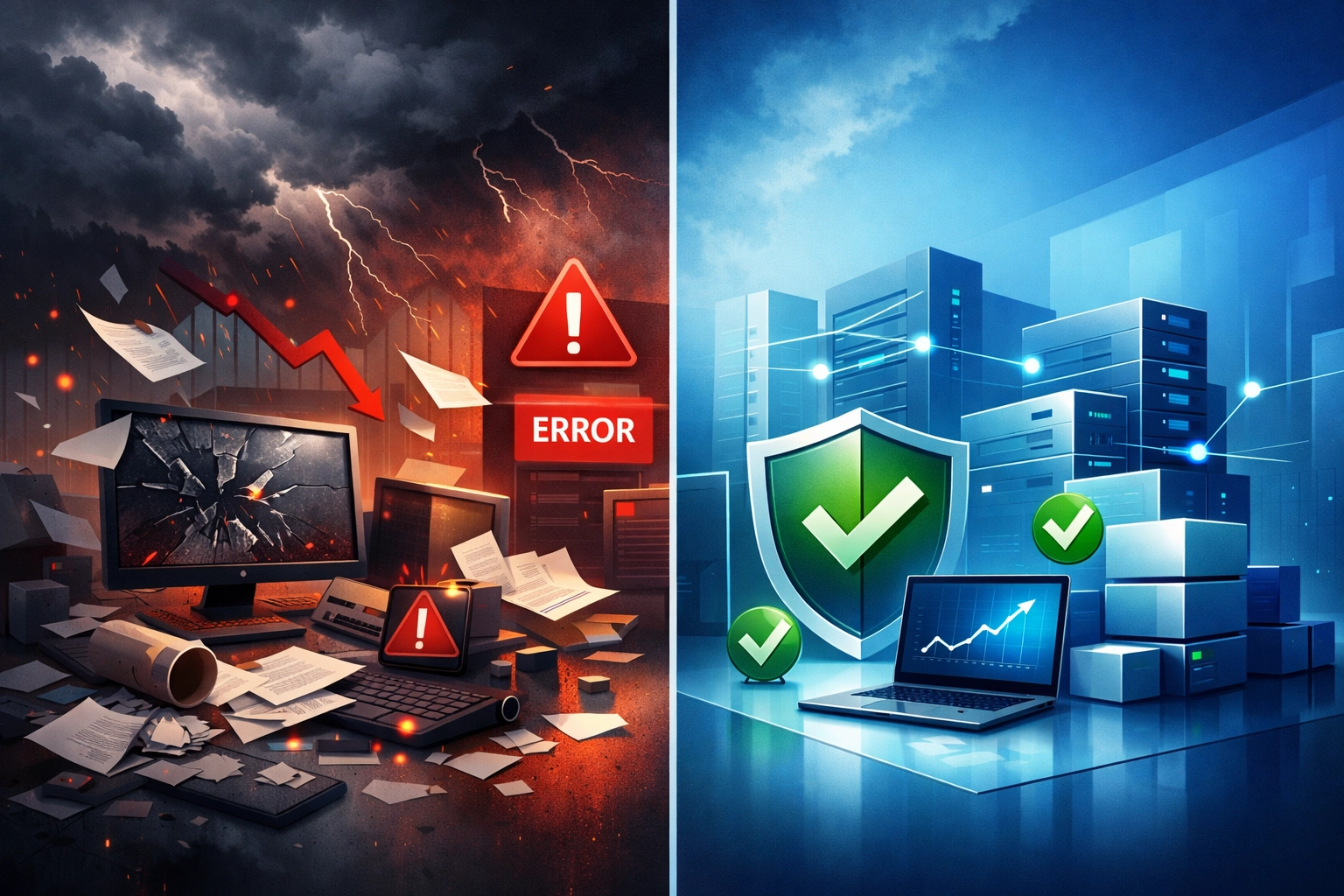
Most small businesses benefit from managed IT services.
The same threats target your business as Fortune 500 companies. The same compliance requirements apply. But your resources are limited.
Managed services bridge this gap.
Predictable costs replace surprise expenses. Specialized expertise becomes accessible. Downtime decreases. Security improves. Compliance requirements are met.
The question is not whether you need IT support. The question is whether handling it internally makes financial and operational sense.
For most businesses under 100 employees, the answer is clear.
Next Steps
Evaluate your current IT situation against the decision framework above.
If your business matches the strong candidate profile, managed IT services will likely improve operations while reducing risk.
Have Questions? Contact us at 815-516-8075 or request more information about how managed IT services can support your specific business needs.
We provide comprehensive IT services to small and medium-sized businesses throughout the region. Our team brings expertise in network security, cloud migration, compliance management, and strategic IT planning.
Every business has unique technology requirements. We assess your current environment and recommend solutions that align with your operational goals and budget constraints.