

Budget IT support looks attractive on paper.
$125-150 per hour versus $150-200 per workstation monthly from professional firms.
The math seems simple.
It isn't.
The Breakdown-Fix Model
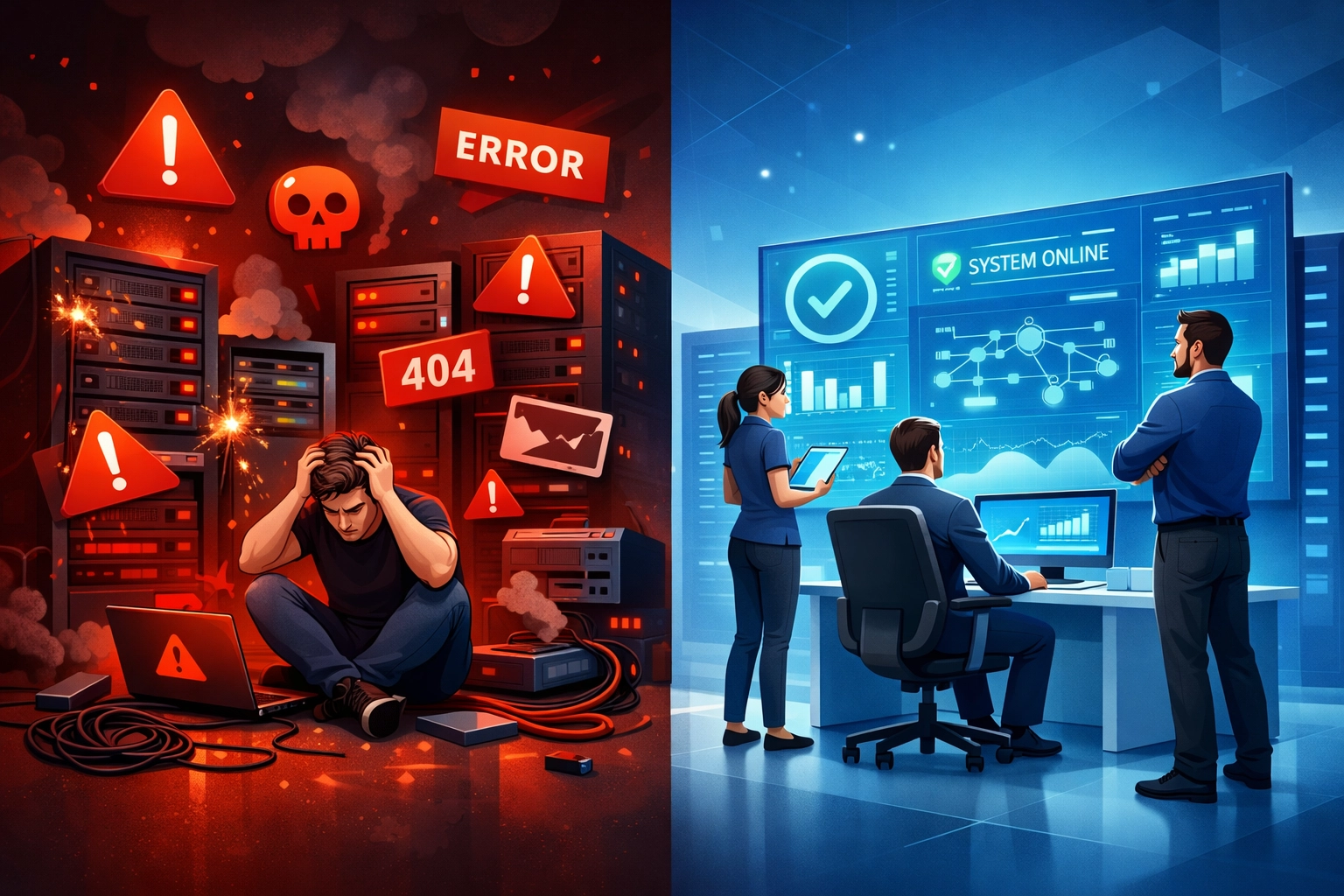
Cheap providers operate reactively.
Problems get addressed after they occur. Not before.
This means:
- Server crashes happen first
- Data loss occurs before backup verification
- Security breaches expose vulnerabilities already exploited
- Network failures interrupt business operations
Recovery costs exceed prevention costs.
Every time.
Response Time Economics
Budget providers handle too many clients with minimal staff.
Average response time: 4-6 hours.
Professional IT support for small business: 15 minutes.
Calculate the difference during a critical system failure.
Six hours of downtime across ten employees at $30/hour average compensation equals $1,800 in lost productivity. Add missed sales, delayed shipments, customer service failures.
The meter runs while waiting for callback.
Hidden Fees Structure
Low advertised rates exclude standard services.
Additional charges typically apply for:
- On-site visits
- After-hours emergency support
- Security monitoring tools
- Backup storage
- Software updates and patches
- Server maintenance
- New user configuration
- Hardware installation
Professional managed services include these items in base pricing.
Budget providers itemize each one.
The invoice tells the real story.

Security Gap Costs
Cheap IT support cuts corners on cybersecurity infrastructure.
Common omissions:
- Multi-layered firewall protection
- Employee phishing simulation training
- Network segmentation
- Endpoint detection and response tools
- Dark web monitoring
- Security patch management
One ransomware incident averages $150,000 in direct costs.
Lost business and reputation damage add to that figure.
Compliance violations for healthcare or financial services firms start at $50,000 per incident.
Prevention costs less than remediation.
Significantly less.
The Backup Problem
Budget providers offer basic backup services.
What gets excluded:
- Backup verification testing
- Off-site redundancy
- Cloud application backup
- Regular restoration drills
- Compliance-aligned retention schedules
Failed backups get discovered during recovery attempts.
Too late.
Data recovery from corrupted or incomplete backups costs $80,000 on average.
Some data never gets recovered.

Staffing and Expertise
Low-cost providers rely on junior technicians or outsourced overseas support.
Generic troubleshooting replaces specialized knowledge.
Recurring issues persist because root causes remain unaddressed.
Professional firms assign dedicated account teams with business-specific expertise.
Problems get solved permanently.
Not repeatedly.
The Real Cost Comparison
Example scenario:
Budget provider annual cost: $48,000
Professional managed IT annual cost: $120,000
Apparent savings: $72,000
Hidden costs from budget provider:
- Single ransomware incident: $150,000
- Data recovery failure: $80,000
- Compliance violation: $50,000
- Emergency support fees: $30,000
Total downstream expense: $310,000
Net loss versus professional support: $238,000
This calculation excludes productivity losses from slow response times and recurring issues.
Proactive vs Reactive Approach
Professional IT support for small business operates proactively.
Systems get monitored continuously.
Issues are identified and remediated before impact.
Updates and patches deploy automatically on tested schedules.
Security protocols receive regular assessment and adjustment.
Disaster recovery plans get tested quarterly.
Budget providers respond to tickets.
Nothing more.

Small Team Limitations
Cheap IT support operates with minimal staffing.
One or two technicians handle hundreds of clients.
Consequences:
- Delayed response during high-volume periods
- Limited availability for strategic planning
- No coverage during vacations or sick days
- Inability to handle multiple simultaneous emergencies
Professional firms maintain redundant coverage.
Account teams include multiple certified technicians.
Backup resources deploy immediately during high-demand situations.
Long-Term Business Impact
Technology infrastructure requires ongoing optimization.
Network architecture evolves with business growth.
Security threats change daily.
Software platforms update regularly.
Budget providers lack capacity for strategic IT planning.
Systems become outdated.
Performance degrades.
Security vulnerabilities accumulate.
Professional managed services include quarterly business reviews and technology roadmapping.
Infrastructure scales with organizational needs.
The Break-Fix Cycle
Cheap support perpetuates a break-fix cycle.
Equipment failures occur without warning.
Staff productivity drops during outages.
Emergency repairs exceed planned maintenance costs.
The cycle repeats.
Professional monitoring prevents most failures before they occur.
Predictive maintenance replaces emergency response.
Costs become predictable.
Operations remain stable.

Making the Transition
Switching from budget to professional IT support requires assessment.
Current infrastructure needs evaluation.
Security gaps require identification.
Backup systems need verification.
Compliance requirements must be documented.
The transition takes 30-60 days typically.
Results appear immediately in reduced downtime and improved security posture.
Bottom Line
Cheap IT support creates expensive problems.
Professional IT support for small business prevents them.
The difference shows in operational stability, security resilience, and total cost of ownership.
Initial savings disappear quickly under hidden fees and incident costs.
Long-term value comes from proactive management and strategic planning.
Your business deserves reliable technology infrastructure.
Not emergency firefighting.
Have Questions? Contact us at 815-516-8075 or request more information.