
Analysis
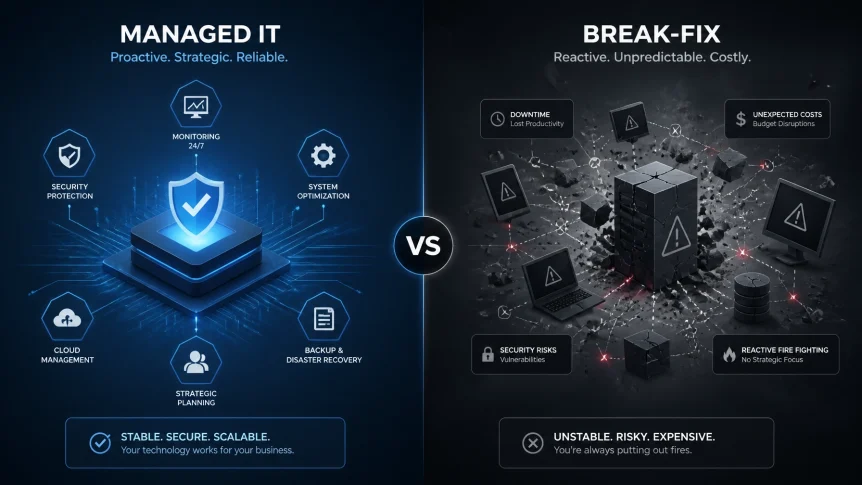
Small business technology management involves two primary financial models.
Break-fix IT involves reactive repairs.
Managed IT services utilize proactive maintenance.
Budget impact varies by operational scale.
Criticality of uptime dictates the preferred strategy.
X-Tek provides comparative data for informed decision-making.
Break-Fix Model
Systems are operated until failure occurs.
Technical assistance is requested post-incident.
Invoices are generated based on hourly labor rates.
Parts and emergency fees are billed separately.
No ongoing service commitment is required.
Resource allocation is strictly reactive.
Budget Characteristics: Break-Fix
Monthly costs fluctuate.
IT spending is categorized as variable expenses.
No recurring subscription fees are present.
Emergency repairs result in high, unplanned costs.
Labor rates increase for after-hours or urgent requests.
Budget forecasting is difficult or impossible.
Total cost of ownership is often higher over 24 months.
Risks
Security gaps remain unpatched between incidents.
Data loss probability increases without verified backups.
Downtime duration is prolonged.
Technicians lack familiarity with internal environment.
Hardware lifecycles are unmanaged.
Cybersecurity threats are addressed only after a breach occurs.
Managed IT Services
Technology is monitored 24/7.
Maintenance tasks are automated.
Security updates are deployed immediately.
One flat monthly fee covers all included services.
Operational stability is the primary objective.
Strategic planning is included in the service scope.

Budget Characteristics: Managed IT
IT costs are moved to an OpEx (operating expense) model.
Monthly bills are predictable and fixed.
Long-term financial planning is supported.
Infrastructure replacement is planned and budgeted.
Labor costs for routine maintenance are included.
Expensive emergency fees are avoided.
Efficiency gains offset the monthly service fee.
Managed IT Features
Network security monitoring is continuous.
Cloud migration is facilitated.
VOIP telephony systems are managed.
Server and workstation health is tracked.
Domain registration and hosting are integrated.
Technical documentation is maintained.
Infrastructure
Server hardware is monitored for performance issues.
Firmware updates are applied during scheduled windows.
Storage capacity is tracked and expanded as needed.
Network switches and routers are optimized.
Redundancy is implemented to prevent single points of failure.
Legacy systems are identified for decommissioning.
Security
Antivirus and anti-malware software is managed.
Firewall rules are reviewed and updated.
Vulnerability scans are performed regularly.
Threat remediation is handled by X-Tek staff.
Multi-factor authentication is enforced across platforms.
Phishing simulations are utilized for user training.

Downtime Impact
Revenue loss occurs during system outages.
Employee productivity stops when tools are unavailable.
Customer satisfaction declines due to service delays.
Break-fix response times depend on technician availability.
Managed IT utilizes Service Level Agreements (SLAs).
Proactive alerts often resolve issues before users are affected.
Cloud Services
Microsoft 365 and Google Workspace environments are managed.
Cloud backups are automated and verified.
Remote access solutions are secured.
Data migration from on-premise hardware is supported.
Scalability is improved through cloud resource allocation.
Subscription costs are optimized to prevent waste.
VOIP Telephony
Cloud-based phone systems replace traditional landlines.
Call routing and automated attendants are configured.
Maintenance is handled remotely by X-Tek.
Hardware costs are reduced through softphone integration.
Communication continuity is maintained during local outages.
Monthly voice service costs are stabilized.
Comparison
| Metric | Break-Fix | Managed IT |
|---|---|---|
| Monthly Cost | $0 – $10,000+ | Fixed / Predictable |
| Security | Reactive / Vulnerable | Proactive / Monitored |
| Maintenance | Minimal | Continuous |
| Downtime | High / Prolonged | Low / Minimized |
| Strategic Planning | None | Included |
| Business Focus | Fixing Problems | Preventing Problems |

Financial Considerations
Break-fix seems cheaper during months without issues.
One major network failure can exceed an annual managed service budget.
Internal staff time spent troubleshooting is an invisible cost.
Managed IT allows for accurate 12-month budget projections.
Investment in Uptime protects revenue.
Technology is treated as a growth asset rather than a repair liability.
Operations
Maintenance is performed M-F 9AM-5pm Central Time.
Monitoring systems operate 24/7/365.
On-site and remote support options are available.
Infrastructure design is customized for SMB needs.
Vendor management is handled by X-Tek.
Service details are available on the Services page.
Decision Criteria
Assess current downtime costs.
Review historical IT repair invoices.
Evaluate the importance of data security.
Consider the complexity of existing infrastructure.
Determine the need for predictable monthly cash flow.
Managed IT is recommended for businesses requiring reliability.

Inquiry
Detailed service information is provided upon request.
Environment assessments identify potential savings.
Custom infrastructure plans are developed for each client.
Transition from break-fix to managed services is structured.
Security audits are recommended for new environments.
Contact X-Tek for more information through the Business Solutions Information Request.
Have Questions?
https://xtekit.com/business-solutions-information-request/
Notifications
All updates are logged.
Reports are provided to clients.
Security posture is documented.
Capacity planning is reviewed quarterly.
Compliance requirements are addressed through managed protocols.
X-Tek Support
Business Hours: Monday – Friday, 9:00 AM – 5:00 PM Central
Business Solutions Information Request: https://xtekit.com/business-solutions-information-request/
Phone: 815-516-8075
{“@type”:”BlogPosting”,”image”:[“https://cdn.marblism.com/mtad57Wntp4.webp”,”https://cdn.marblism.com/bwN0q-mS2xa.webp”,”https://cdn.marblism.com/4xU8A8FmI-e.webp”,”https://cdn.marblism.com/prS_N7bJEP9.webp”,”https://cdn.marblism.com/_coptSWTAn_.webp”],”author”:{“name”:”X-Tek”,”@type”:”Organization”},”@context”:”https://schema.org”,”headline”:”Managed IT Services Vs. Break-Fix IT: Which Is Better For Your Small Business Budget?”,”publisher”:{“logo”:{“url”:”https://xtekit.com/wp-content/uploads/2022/01/X-Tek-Logo.png”,”@type”:”ImageObject”},”name”:”X-Tek”,”@type”:”Organization”},”articleBody”:”Small business technology management involves two primary financial models. Break-fix IT involves reactive repairs. Managed IT services utilize proactive maintenance. Budget impact varies by operational scale. Criticality of uptime dictates the preferred strategy. X-Tek provides comparative data for informed decision-making. Systems are operated until failure occurs. Technical assistance is requested post-incident. Invoices are generated based on hourly labor rates. Parts and emergency fees are billed separately. No ongoing service commitment is required. Resource allocation is strictly reactive. Monthly costs fluctuate. IT spending is categorized as variable expenses. No recurring subscription fees are present. Emergency repairs result in high, unplanned costs. Labor rates increase for after-hours or urgent requests. Budget forecasting is difficult or impossible. Total cost of ownership is often higher over 24 months.”,”description”:”A comprehensive comparison of Managed IT Services and Break-Fix IT models for small to medium-sized business budgets, focusing on cost predictability, security, and uptime.”,”datePublished”:”2026-06-02″}