
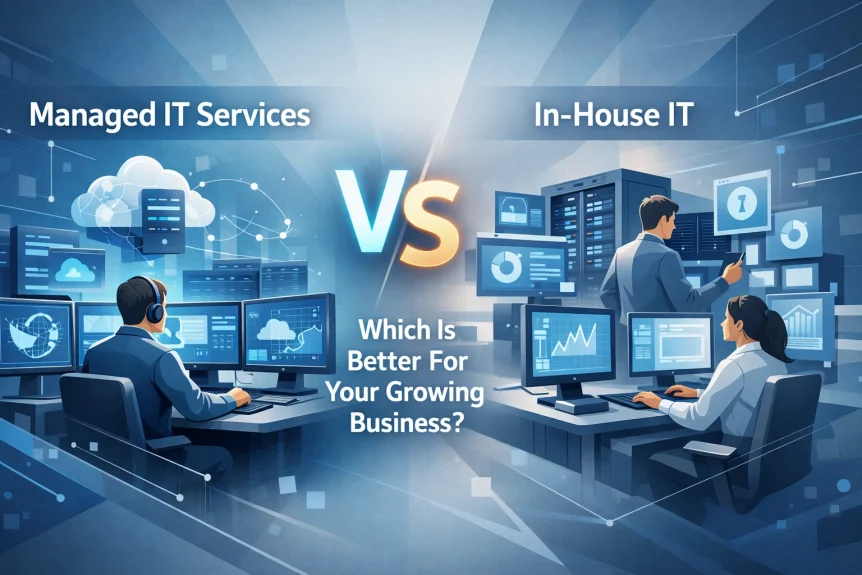
Growing businesses face a decision point with IT support.
Build an internal team or partner with a managed service provider.
The choice impacts budget, scalability, and operational capacity.
Cost Structure Comparison
In-House IT Teams
A 50-person company typically requires 1-2 IT managers.
Annual cost: $125,000-$190,000 plus benefits.
Additional expenses include:
- Hardware and software tools
- Training and certifications
- Recruitment costs for expansion
- Benefits packages (health insurance, retirement, paid time off)
Coverage limitations exist. Evenings and weekends require overtime or remain unmonitored.
Managed IT Services
Same 50-person company cost: $60,000-$180,000 annually.
Included in standard agreements:
- 24/7 monitoring and support
- Security operations
- Multiple specialist roles
- Tool and platform licenses
- Weekend and holiday coverage

Costs remain predictable. Monthly fee covers expanded services as needs evolve.
Scalability Factors
In-House Limitations
Team expansion requires:
- Job postings and recruitment
- Interviewing and vetting candidates
- Onboarding period (2-3 months typical)
- Training on company systems
Technology changes demand additional hiring or external training investments.
Growing from 50 to 100 employees doubles IT requirements. Timeline to scale an internal team: 3-6 months minimum.
Managed Service Advantages
MSPs scale instantly.
Add 50 users. Support infrastructure adjusts within days.
Open new location. Network monitoring and security extend automatically.
Deploy new software stack. Specialists already trained and available.
No recruitment delays. No training periods. No benefit negotiations.

Expertise Access
In-House Capacity
Single IT manager provides:
- Help desk support
- Basic network management
- Software troubleshooting
- User administration
Specialized skills require additional hires:
- Cybersecurity analyst: $90,000-$140,000
- Cloud architect: $110,000-$160,000
- Network engineer: $80,000-$120,000
- Compliance specialist: $85,000-$130,000
Most growing businesses cannot justify these expenses.
MSP Resources
Managed services provide access to full specialist teams.
Included expertise:
- Security operations and threat monitoring
- Cloud infrastructure design and migration
- Network architecture and optimization
- Compliance management (HIPAA, PCI-DSS, GDPR)
- Disaster recovery planning
- VOIP and telecommunications
- Vendor management
Technology evolves rapidly. MSPs maintain current certifications and training across all service areas.
Control and Response Considerations
In-House Benefits
On-site presence enables:
- Immediate physical access to systems
- Direct oversight of all IT operations
- Deep knowledge of company processes
- Alignment with business strategy
- Vested interest in company success
Response time for on-site issues: minutes.
IT staff attend internal meetings and planning sessions.
Managed Service Structure
Remote monitoring handles most issues.
On-site visits scheduled as needed.
Response times defined in service level agreements:
- Critical issues: 1-4 hours
- High priority: 4-8 hours
- Standard requests: 24-48 hours
Strategic direction requires clear communication with provider.
MSPs serve multiple clients. Familiarity with specific business processes develops over time.

Hybrid Approach
Co-managed IT combines both models.
Structure
Maintain 1-2 internal IT staff for:
- Day-to-day user support
- Strategic planning and oversight
- Vendor relationship management
- Internal project coordination
Partner with MSP for:
- 24/7 network monitoring
- Security operations center functions
- Infrastructure management
- Specialized technical projects
- After-hours support
Advantages
Immediate on-site presence maintained.
Access to specialist expertise preserved.
Costs lower than full in-house team.
Scalability remains flexible.
Considerations
Requires coordination between internal staff and external provider.
Communication protocols must be established.
Typically suited for companies with 100+ employees.
Decision Framework
Choose In-House When:
Budget supports $200,000+ annually for IT operations.
Business requires constant on-site presence.
Industry regulations demand direct employee oversight.
IT infrastructure remains stable with minimal growth planned.
Control over all technical decisions is priority.
Choose Managed Services When:
Growth trajectory is 15%+ annually.
Budget constraints limit specialist hiring.
24/7 monitoring and security are required.
Technology needs vary throughout the year.
Focus on core business operations is priority.
Choose Hybrid When:
Company size exceeds 100 employees.
Budget supports 1-2 internal IT positions plus MSP partnership.
Strategic IT oversight matters but specialist expertise is needed.
Compliance requirements benefit from dedicated internal oversight.

Common Growing Business Scenarios
Scenario 1: 25-Employee Professional Services Firm
Current state: Owner's nephew handles IT part-time.
Growth plan: Add 15 employees within 18 months.
Managed services fit. Cost-effective specialist access without full-time hiring commitment.
Scenario 2: 75-Employee Manufacturing Company
Current state: One IT generalist on staff.
Growth plan: Implement new ERP system and expand to second facility.
Hybrid approach fits. Keep existing IT manager. Add MSP for infrastructure and specialized support.
Scenario 3: 150-Employee Healthcare Provider
Current state: Two-person IT team stretched thin.
Growth plan: HIPAA compliance tightening. Ransomware concerns increasing.
Co-managed services fit. Maintain internal team for clinical system oversight. Add MSP for security operations and compliance management.
Making the Decision
Assess current IT spending.
Calculate actual costs including:
- Salaries and benefits
- Software licenses
- Hardware refresh cycles
- Training expenses
- Opportunity cost of downtime
Project growth over 24 months.
Determine required specialist skills for planned initiatives.
Evaluate risk tolerance for after-hours incidents.
Compare total cost of ownership across options.
Implementation Considerations
Transitioning to Managed Services
Documentation of current systems required.
Onboarding period: 30-60 days typical.
User communication plan necessary.
Service level agreements define response times and coverage.
Building In-House Team
Recruitment timeline: 2-4 months per position.
Tool procurement and setup: 1-2 months.
Process development and documentation ongoing.
Get Expert Guidance
IT infrastructure decisions impact operations for years.
We help businesses evaluate their specific requirements and growth trajectory.
Call 815-516-8075 to discuss your situation.
Have Questions? Connect with our team for a detailed assessment.
Your IT approach should enable growth, not constrain it.