
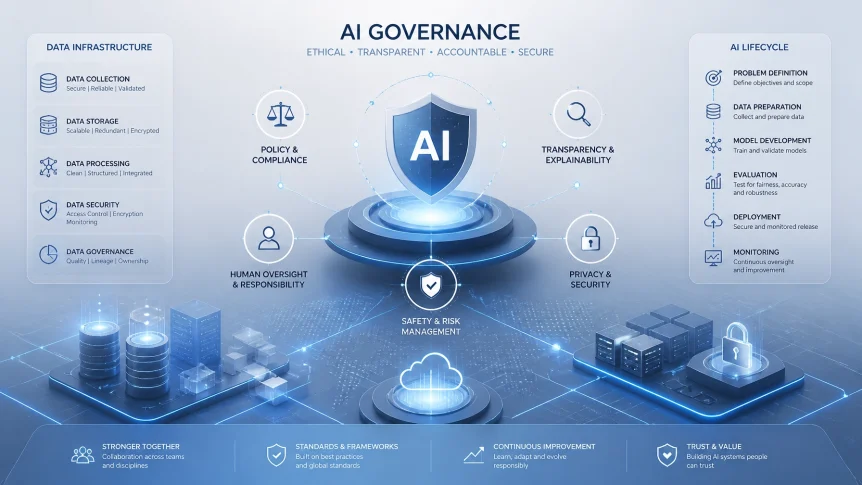
Deployment of Artificial Intelligence (AI) within small and medium businesses (SMBs) requires formal oversight structures.
Adoption without governance introduces operational, legal, and security risks.
Management of AI tools is now a business necessity.
Operational Date: July 10, 2026
Category: blog
Inventory
Establishment of a comprehensive AI inventory is the primary requirement.
Undocumented use of AI (Shadow IT) is common in modern workforces.
Identification of all active and planned AI implementations is necessary.
Inventory Checklist:
- Direct LLM access (ChatGPT, Claude, Gemini)
- Embedded AI in SaaS (CRM smart features, HR screening tools, Microsoft 365 Copilot)
- Browser extensions with AI capabilities
- Development tools (GitHub Copilot, Cursor)
- Customer-facing chatbots
Data Mapping:
For every identified tool, the following must be documented:
- Tool name and vendor details
- Internal business owner
- Specific use case
- Types of data accessed (PII, financial records, intellectual property)
- Storage location of generated outputs

Risk Categorization
All identified AI systems are assigned a risk tier.
Resources are prioritized based on the potential impact of tool failure or data breach.
Tier 1: High Risk
- Systems influencing employment or hiring decisions
- Financial credit scoring or lending algorithms
- Medical or health-related analysis
- Processing of highly sensitive PII
- Action: Requires formal security audit and manual human verification of all outputs.
Tier 2: Medium Risk
- Customer-facing communication (Sales bots, support chat)
- Internal data analysis for strategic decisions
- Marketing content generation referencing specific product specs
- Action: Requires periodic sampling and accuracy checks.
Tier 3: Low Risk
- Internal brainstorming and drafting
- Coding assistance for non-production environments
- Meeting summarization (non-confidential)
- Action: Standard usage policy compliance.
Security and compliance are maintained through these tiers.

Policy Development
A formal AI Usage Policy must be disseminated to all personnel.
Fragmented guidelines are insufficient for enterprise-level security.
Core Policy Elements:
- Prohibition of uploading sensitive corporate data to public AI models
- Mandatory disclosure of AI usage in client-facing work
- Required human-in-the-loop (HITL) for critical decision-making
- Copyright and ownership clarity for AI-generated assets
- Incident reporting procedures for AI hallucinations or data leaks
Operational Governance:
- Establishment of a virtual AI committee
- Membership: IT lead, Security lead, Department head
- Function: Approval of new AI tools and quarterly risk reviews
Internal resources for policy development are found on the X-Tek blog.
Monitoring
Continuous oversight ensures AI systems remain within defined guardrails.
Models are prone to drift and performance degradation over time.
Monitoring Requirements:
- Accuracy tracking for automated outputs
- Bias detection in decision-making algorithms
- Vendor update monitoring (tracking changes in model behavior)
- Logs of user prompts and system responses
- Feedback loops for staff to report anomalies

Audit Trails
Maintenance of a central governance log is required for compliance.
Documentation must be ready for regulatory inspection.
Log Components:
- Version history of internal prompts and RAG (Retrieval-Augmented Generation) datasets
- Records of security patches and vendor compliance updates
- Summary of internal training sessions
- Documentation of any AI-related security incidents and remediations
X-Tek manages these technical oversight processes.
Summary of immediate actions:
- Conduct discovery for all AI tools.
- Assign risk tiers to each system.
- Publish a formal AI usage policy.
Contact Information
Business Solutions Information Request:
https://xtekit.com/business-solutions-information-request/
815-516-8075
{“name”:”Your Quick-Start Guide to AI Governance: Do These 3 Things First”,”step”:[{“name”:”Inventory and Categorize”,”text”:”Identify all AI tools in use, including shadow IT and embedded SaaS features, and document data access and ownership.”,”@type”:”HowToStep”},{“name”:”Establish Risk-Based Guardrails”,”text”:”Assign risk tiers to all AI systems and develop a formal usage policy that includes data protection rules and human-in-the-loop requirements.”,”@type”:”HowToStep”},{“name”:”Implement Continuous Monitoring”,”text”:”Set up oversight mechanisms to track model performance, bias, and accuracy, maintaining a detailed audit log for compliance.”,”@type”:”HowToStep”}],”@type”:”HowTo”,”@context”:”https://schema.org”,”publisher”:{“url”:”https://xtekit.com”,”name”:”X-Tek”,”@type”:”Organization”},”description”:”A technical guide for SMBs to implement basic AI governance structures through inventory, risk categorization, and oversight.”,”datePublished”:”2026-07-10″}