
Overview
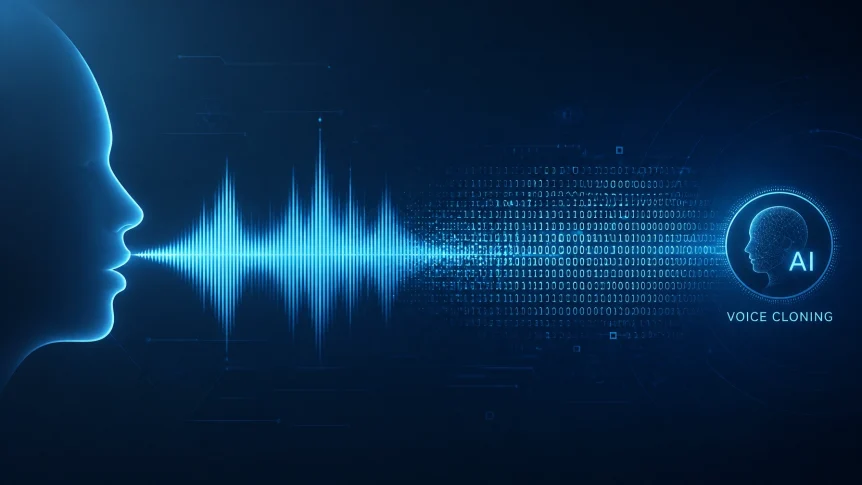
AI voice cloning technology enables synthetic reproduction of human speech.
Machine learning models analyze tone, cadence, and inflection.
Clones are generated from 3 to 30 seconds of audio data.
Technology is used for both operational efficiency and malicious exploitation.
Voice-based identity verification is no longer a reliable security control.
Definitions
AI Voice Cloning
Creation of a digital copy of a specific human voice.
Requires high-quality audio samples for training.
Produces synthetic speech with emotional nuance.
Vishing
Voice phishing using cloned audio.
Impersonation of trusted individuals via phone or voicemail.
Generative AI
Underlying technology facilitating synthetic media creation.
Used in customer service, marketing, and fraudulent activities.

Risks
Identity Impersonation
Attackers clone voices of executives or department heads.
Urgent requests for fund transfers are made via phone.
Social engineering success rates increase with high-fidelity audio.
Credential Theft
Help desks are targeted by callers posing as employees.
MFA resets are requested using synthetic voices.
Password changes are authorized based on perceived vocal identity.
Financial Loss
Unauthorized wire transfers are initiated via voice command.
Banking details are altered through fraudulent phone interactions.
Ransomware deployment often follows successful credential harvesting.
Legal and Regulatory Liability
Compromise of sensitive data triggers GDPR, HIPAA, or PCI DSS violations.
Reputational damage occurs following publicized security breaches.
Voice recordings are no longer admissible as sole proof of authorization.

Security Protocols
Verification Requirements
Voice is treated as an untrusted channel.
Multi-factor authentication (MFA) is required for all access requests.
Out-of-band verification is mandatory for financial transactions.
Call-back procedures are implemented using verified numbers on file.
Help Desk Hardening
Strict identity verification policies are enforced.
Visual ID or secondary digital tokens are required for account resets.
MFA changes must be approved by two separate authorized users.
All verification steps are logged and audited in real-time.
Internal Training
Staff are educated on vishing red flags.
Policies regarding "no voice-only approvals" are communicated.
Simulation drills are conducted to test employee response to deepfakes.
Managed Security Services
Network traffic and endpoint behavior are monitored and remediated.
Proactive security measures are managed by X-Tek.
Refer to X-Tek security fix guide for additional protection.

Business Benefits
Customer Interaction
AI-powered voice agents provide 24/7 support.
Appointment scheduling is automated.
Branded voices maintain consistency across phone channels.
See VOIP phone systems for integration details.
Content Production
Marketing audio is generated without studio recording.
Training materials are localized into multiple languages.
Production costs for instructional videos are reduced.
Scalability
High volumes of personalized audio are produced efficiently.
Support loads are managed without additional headcount.
Cloud-based AI services enable rapid deployment for SMBs.
Explore cloud migration for AI scalability.
Implementation Roadmap
Step 1: Audit
Identify current reliance on voice verification.
Catalog existing audio assets and public recordings.
Assess vulnerability of finance and IT departments.
Step 2: Policy Update
Remove voice-only authorization from company handbooks.
Implement mandatory MFA for all sensitive systems.
Draft consent forms for any internal voice cloning projects.
Step 3: Vendor Selection
Select AI platforms with enterprise-grade encryption.
Ensure providers offer audit logs and SSO integration.
Verify data privacy policies regarding voice training data.
Step 4: Infrastructure Alignment
Ensure network setup supports AI-driven traffic.
Integrate AI voice agents with existing VOIP systems.
Deploy managed IT solutions for continuous monitoring.

Operations
Managed IT support plans are provided by X-Tek.
Server and PC maintenance is conducted remotely and on-site.
Network infrastructure is designed for modern AI demands.
Security monitoring is performed 24/7.
Cloud services from Google and Microsoft are supported.
VOIP telephony systems are maintained for reliability.
Technical Specifications
Model Training
Small-sample learning (SSL) used for quick cloning.
High-fidelity output requires 44.1kHz sample rates.
Neutral tone samples are preferred for versatility.
Detection Tools
Spectral analysis identifies synthetic artifacts.
Metadata verification checks for digital manipulation.
AI-driven detection software is integrated into security stacks.
Summary
AI voice cloning provides significant operational advantages.
Security risks necessitate immediate protocol adjustments.
Voice is no longer a valid security factor.
Implementation requires professional oversight.
X-Tek manages and secures business technology environments.
Contact Information
Business Solutions Information Request:
https://xtekit.com/business-solutions-information-request/
815-516-8075
{“@type”:”BlogPosting”,”image”:”https://cdn.marblism.com/2u17FqyD4WB.webp”,”author”:{“name”:”X-Tek”,”@type”:”Organization”},”@context”:”https://schema.org”,”headline”:”Are Deepfakes Bad? The Truth About AI Voice Cloning for Business”,”keywords”:”AI for small business, generative AI for business IT, AI security for SMBs, managed AI services, AI-powered IT support, implementing AI in small business IT, AI and cybersecurity for business”,”publisher”:{“logo”:{“url”:”https://xtekit.com/wp-content/uploads/2023/04/x-tek-logo.png”,”@type”:”ImageObject”},”name”:”X-Tek”,”@type”:”Organization”},”description”:”A technical overview of AI voice cloning risks and benefits for small businesses, covering vishing security and operational utility.”,”datePublished”:”2026-07-07″,”articleSection”:”blog”}