
Category: blog
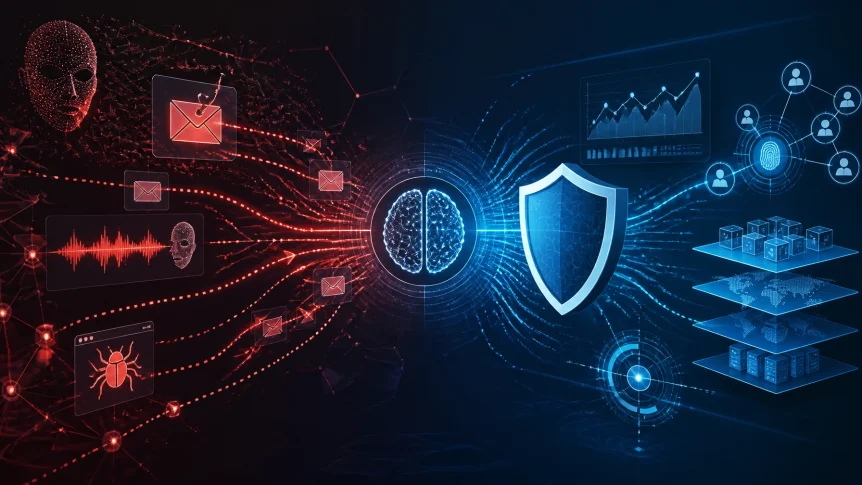
AI is changing both sides of cybersecurity.
Attackers are using it to:
- Generate phishing campaigns
- Clone voices
- Create convincing business email compromise messages
- Automate vulnerability discovery
- Modify malware behavior
- Bypass traditional security controls
- Target more businesses at lower cost
Defenders are using it to:
- Detect abnormal activity
- Correlate events across systems
- Identify compromised accounts
- Block suspicious messages
- Prioritize security alerts
- Automate remediation
- Monitor infrastructure continuously
The result is an expanding AI arms race.
SMBs are being affected because automated attacks do not require a large security team to be profitable. Attack tools can scan thousands of businesses, identify exposed systems, and deliver targeted campaigns without manual effort.
Managed security is becoming a baseline requirement for 2026.
AI Has Changed the Threat Model
Traditional attacks often required preparation and manual execution.
Messages were sent in limited volumes.
Malware used recognizable signatures.
Credential theft depended on poorly written phishing emails.
Security teams had more time to identify patterns.
AI reduces that time.
Phishing content can be generated for a specific employee, vendor, department, or executive. Public information can be used to imitate writing style, business terminology, and common workflows.
The message may contain:
- Correct names
- Accurate job titles
- Familiar project details
- Current vendor information
- Normal business language
- A realistic payment or login request
Grammar errors are no longer a reliable warning sign.
The FBI’s 2025 IC3 Annual Report reported more than 22,000 complaints involving AI-related information and adjusted losses exceeding $893 million. Business email compromise remains a major category.
AI is not replacing established attack methods.
It is increasing their speed, scale, and consistency.
The Main AI-Enabled Threats

AI-Generated Phishing
AI-generated phishing messages can be produced in large volumes and adapted to individual recipients.
Attackers can create separate versions for:
- Accounting staff
- Human resources
- Executives
- Customers
- Vendors
- Remote employees
- IT administrators
The objective remains familiar.
Credentials are collected.
MFA approvals are requested.
Malicious links are opened.
Payment instructions are changed.
Email accounts are compromised.
The message is more difficult to identify because it may match the recipient’s normal business context.
Voice Cloning and Deepfakes
Voice and video impersonation are being added to business fraud campaigns.
A request that begins by email may be reinforced by:
- A phone call using a cloned voice
- A video meeting using manipulated media
- A text message from an impersonated executive
- A second message appearing to confirm the request
This creates a false chain of verification.
The request may involve:
- Vendor banking changes
- Payroll updates
- Wire transfers
- Gift card purchases
- Tax documents
- Customer records
- Administrative credentials
Voice or video must not be treated as independent identity verification.
Payment changes require an out-of-band confirmation using a known phone number or established vendor portal.
High-value payments should require dual approval.
AI-Enhanced Malware
AI can support malware development and distribution.
Attackers can use automated tools to:
- Identify vulnerable systems
- Modify malicious code
- Test evasion methods
- Create targeted payloads
- Select effective delivery methods
- Automate command execution
Traditional antivirus remains useful.
It is not sufficient by itself.
Behavior-based detection is required because new malware may not match an existing signature. Suspicious process activity, unusual authentication, mass file changes, and abnormal network connections must be monitored.
Fake AI Tools and Malicious Packages
AI tools are now being used throughout business operations.
Employees may install:
- Browser extensions
- Productivity plugins
- Automation tools
- Code packages
- AI assistants
- Third-party integrations
Attackers use fake tools and compromised packages to distribute malware or collect credentials.
Approved software lists are required.
Package sources must be reviewed.
Administrative installation rights should be limited.
Vendor and application access must be documented.
Shadow AI and Data Exposure
Employees may use unapproved AI services for routine work.
Sensitive information may be entered into public systems without review.
Potentially exposed data includes:
- Customer records
- Financial information
- Contracts
- Employee data
- Source code
- Network details
- Credentials
- Internal procedures
AI usage policies should define:
- Approved tools
- Prohibited data
- Required account configuration
- Retention expectations
- Access permissions
- Vendor review requirements
- Incident reporting procedures
AI agents require additional controls.
An agent with access to email, cloud storage, accounting systems, or customer databases can create risk if permissions are excessive or integrations are misconfigured.
AI Is Also Changing Defense

AI-powered security tools are being used to review activity across multiple systems.
They can evaluate:
- Login location
- Device status
- Authentication timing
- Email behavior
- File access
- Process execution
- Network traffic
- Privilege changes
- Cloud application activity
A single event may not indicate a breach.
Several related events may.
For example:
- An employee signs in from an unfamiliar location
- A new device is registered
- A mailbox forwarding rule is created
- A large number of files are accessed
- A payment-related email is sent
When these events are correlated, a compromised account may be identified earlier.
Behavioral Detection
Signature-based controls look for known indicators.
Behavioral controls look for activity that does not match normal patterns.
Examples include:
- A user accessing systems at unusual hours
- A workstation creating unexpected administrative connections
- A service account accessing new data
- A mailbox sending messages at an unusual volume
- A device communicating with a new external destination
- Multiple failed authentication attempts followed by success
AI-supported detection can help prioritize these events.
It does not eliminate the need for security analysts.
Alerts still require validation.
Automated actions still require defined limits.
Automated Response
Some security platforms can respond to confirmed threats by:
- Isolating an endpoint
- Blocking a domain
- Revoking a session
- Disabling an account
- Removing a malicious email
- Stopping a process
- Restricting an application
- Escalating an incident
Response automation reduces the time between detection and containment.
It must be configured carefully.
Incorrect actions can interrupt business operations. Response rules should be based on risk, user role, system importance, and event confidence.
Identity Is the Main Control Point
AI-enabled attacks frequently target identity.
The goal may be access to:
- Microsoft 365
- Google Workspace
- VPN services
- Financial platforms
- Customer management systems
- File storage
- Administrative consoles
MFA should be enabled on all business accounts.
Phishing-resistant MFA should be prioritized for:
- Administrators
- Executives
- Finance staff
- Human resources staff
- Remote access accounts
- Cloud tenant administrators
CISA identifies FIDO and WebAuthn methods as phishing-resistant MFA options. SMS and voice codes should be treated as weaker options where stronger methods are supported.
Additional identity controls include:
- Conditional access
- Device compliance checks
- Separate administrator accounts
- Least-privilege permissions
- Session monitoring
- OAuth application review
- Prompt reporting of unexpected MFA requests
Passwords alone are not an adequate control for 2026.
Email and Financial Controls Must Work Together
Email security can reduce phishing.
It cannot independently stop every payment fraud attempt.
Financial processes are also required.
Controls should include:
- SPF configuration
- DKIM configuration
- DMARC enforcement
- Look-alike domain monitoring
- External email indicators
- Payment change verification
- Dual approval for high-value transfers
- Vendor callbacks using known contact information
- Documented escalation procedures
The FBI’s business email compromise guidance recommends independent verification for payment requests and account changes.
The verification method must not rely on the same potentially compromised communication channel.
A reply to the suspicious email is not independent verification.
Why Managed Security Is Needed in 2026

AI-powered security tools provide coverage.
They do not provide a complete security program without configuration, monitoring, and response.
SMBs often face limitations involving:
- Security staffing
- After-hours coverage
- Alert investigation
- Platform configuration
- Patch management
- Backup testing
- Incident response planning
- Vendor oversight
Threats do not follow business hours.
Suspicious activity may begin overnight, during a weekend, or while staff are unavailable.
Managed security services provide ongoing operations.
Systems are monitored.
Alerts are reviewed.
Threats are investigated.
Confirmed activity is contained.
Security controls are updated.
Backups are checked.
Vulnerabilities are documented.
The X-Tek Secure service provides a reference point for managed security operations. The X-Tek Uptime service addresses availability and monitoring requirements.
Managed services also support security consistency.
Controls are applied across users, endpoints, servers, cloud platforms, and network infrastructure.
Exceptions are identified.
Configuration changes are recorded.
Issues are escalated before they become incidents.
Backup Remains a Core Defense
AI can accelerate ransomware and data destruction.
Backups must be protected from the same environment they are designed to restore.
A business backup strategy should include:
- Separate backup credentials
- Multiple recovery points
- Off-site copies
- Offline or immutable storage
- Encryption
- Access restrictions
- Recovery testing
- Documented recovery procedures
Backup alone does not define business continuity.
Recovery time objectives should be assigned to critical systems.
The X-Tek business continuity guidance addresses the difference between restoring data and restoring operations.
Recovery must be tested.
A backup that has not been restored is an assumption.
A Practical SMB Security Plan
The following controls provide a starting point for 2026:
1. Govern AI Use
Create an approved AI tool list.
Define prohibited data.
Review AI vendors.
Limit agent permissions.
Document integrations.
2. Secure Identity
Require MFA on all business accounts.
Use phishing-resistant MFA for high-risk users.
Review privileged access.
Revoke inactive accounts and sessions.
3. Protect Email
Configure SPF, DKIM, and DMARC.
Use advanced email filtering.
Monitor mailbox forwarding rules.
Train users to report suspicious messages.
4. Monitor Behavior
Deploy endpoint detection and response.
Centralize identity, email, endpoint, and cloud logs.
Alert on anomalous sign-ins and privilege changes.
Review high-risk events.
5. Verify Financial Requests
Use known contact information.
Require dual approval.
Document vendor change procedures.
Do not approve payments based on voice or video alone.
6. Protect Recovery Systems
Maintain separate backups.
Use off-site and offline storage.
Test restoration.
Document recovery priorities.
7. Use Managed Coverage
Security systems must be monitored after hours.
Alerts must be reviewed.
Incidents must be contained.
Controls must be maintained.
The Operating Standard
AI has increased the speed of attack execution.
Defenses must be monitored and adjusted at the same pace.
The effective model combines:
- Identity security
- Email protection
- Endpoint detection
- Network segmentation
- Cloud monitoring
- Backup protection
- Financial verification
- AI governance
- Employee training
- Managed response
No single AI product addresses all of these requirements.
A managed program is used to coordinate the controls, review activity, and support response.
X-Tek provides managed IT, security monitoring, cloud services, network infrastructure, backup support, and incident response planning for SMBs.
Relevant resources:
- Proactive network security for small businesses
- Network setup and AI-powered attacks
- Managed IT services for SMBs
- Common small business IT security mistakes
Contact Information
Business Solutions Information Request:
https://xtekit.com/business-solutions-information-request/
815-516-8075