
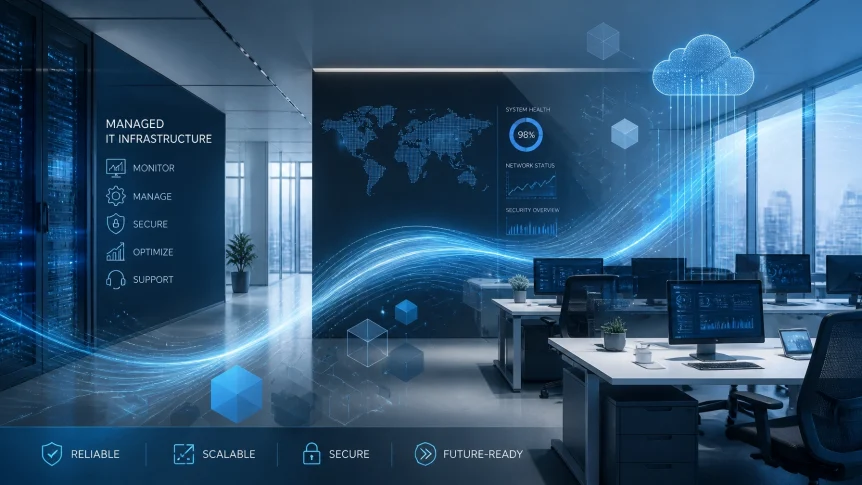
Overview
Selection of an IT service model is critical for small and medium-sized businesses (SMBs)
Operational efficiency depends on reliable infrastructure
Options include fully managed IT services or hybrid co-managed models
Decisions are based on existing internal staff, budget constraints, and technical complexity
Efficiency is prioritized
Cost predictability is required
Infrastructure stability is the objective
Categorization
Managed IT Services:
Total outsourcing of IT operations to X-Tek
No internal IT staff required
Fixed monthly costs
Comprehensive coverage of help desk, security, and cloud
Hybrid IT Models:
Partnership between internal IT staff and X-Tek
Internal staff handles daily local priorities
X-Tek manages specialized projects, 24/7 security, and backups
Increased control and specialized escalation
Comparison
Managed IT Services:
Proactive maintenance is standard
24/7 monitoring and remediation are performed
Hardware and software lifecycles are managed externally
Scalability is immediate for new users or locations
Remote and on-site support are integrated
Small business owners' guide to managed services
Hybrid IT Models:
Local IT manager maintains business-specific knowledge
Complex server environments are co-managed
Specialized skill gaps are filled by external experts
Strategic technology roadmaps are co-developed
Internal IT versus managed IT comparison

Selection Factors
Business Size:
Under 50 employees typically favor fully managed services
Over 50 employees may require hybrid models for local presence
Internal Expertise:
Presence of a dedicated IT employee suggests a hybrid model
Lack of internal technical resources requires fully managed support
Budgeting:
Operational expenses (OpEx) are preferred for managed services
Capital expenses (CapEx) and payroll are balanced in hybrid models
Security Requirements:
Compliance-heavy industries (HIPAA, PCI) require high-level monitoring
Network security monitoring for SMBs
24/7 threat detection is essential for both models
Technical Infrastructure:
Cloud-only environments favor remote managed IT
On-premise servers may benefit from hybrid local support
Cloud vs on-premise server comparison
Managed IT Services Benefits
Reduced Overhead:
Hiring, training, and retention costs are eliminated
Payroll taxes and benefits for IT staff are avoided
Expert Access:
A full team of specialists is available
Expertise in VOIP, cloud migration, and network design is included
Cloud migration guide for SMBs
Proactive Operations:
Updates are deployed automatically
Security patches are applied upon release
Backups are verified daily
24/7 Coverage:
Support is not limited by sick leave or vacations
Systems are monitored during non-business hours

Hybrid IT Model Benefits
Internal Focus:
Company-specific applications are managed locally
In-person hardware troubleshooting is immediate
External Strength:
Advanced cybersecurity tools are provided by X-Tek
Enterprise-level backup solutions are implemented
Strategic vCIO services are utilized for long-term planning
Redundancy:
The MSP serves as a backup for the internal IT person
Documentation is shared to prevent knowledge silos
Single-point-of-failure risks are mitigated
Evaluation Criteria
Technical Capability:
Provider must support PC and MAC environments
Server maintenance and repair experience is required
Network infrastructure design must be a core competency
Service Level Agreements (SLA):
Response times for critical issues must be defined
Resolution targets for low-priority tickets are established
Uptime guarantees for cloud services are reviewed
Security Stack:
Endpoint protection is mandatory
Multi-factor authentication (MFA) is enforced
Firewall management is included
Security awareness training is available
Communication:
Regular business reviews are conducted
Transparent reporting on system health is provided
Clear documentation of the IT environment is maintained

Infrastructure Design
Network Assessment:
Current bottlenecks are identified
Wi-Fi coverage is mapped
Security vulnerabilities are documented
Design Phase:
Scalable architecture is planned
Redundant internet connections are considered
VOIP telephony integration is mapped
VOIP phone system considerations
Implementation:
Hardware is procured and configured
Cabling and racking are completed
Software transitions are managed to minimize downtime
Maintenance:
Firmware is updated regularly
Hardware performance is monitored
Environment is documented continuously
Cloud Services Integration
Assessment:
Application compatibility is verified
Data volume is calculated
Bandwidth requirements are analyzed
Migration:
Email systems (Microsoft 365/Google) are transitioned
File storage is moved to cloud repositories
Security permissions are re-mapped
Optimization:
Cloud costs are monitored
Storage usage is audited
Access logs are reviewed regularly

Security and Monitoring
Threat Detection:
Malware attempts are blocked
Unusual login patterns are flagged
Vulnerability scans are performed monthly
Data Protection:
Local and cloud backups are synchronized
Recovery time objectives (RTO) are set
Disaster recovery tests are conducted annually
Compliance:
Audit logs are maintained
Encryption standards are enforced
Access controls are updated based on employee status
Support Availability:
Remote support is available through X-Tek
On-site visits are scheduled as required
Standard business hours: M-F 9AM-5pm Central Time
Emergency support for critical outages is provided 24/7
Strategic Planning
vCIO Services:
Budget planning is facilitated annually
Hardware refresh cycles are projected
New technology impact is evaluated
Business Continuity:
Risk assessments are updated
Recovery procedures are documented
Communication plans for outages are established
Vendor Management:
Internet service providers are managed
Software licenses are tracked
Equipment warranties are monitored

Final Decision Steps
Step 1: Inventory all current hardware and software assets
Step 2: Define required support hours and response times
Step 3: Evaluate internal staff capacity for IT management
Step 4: Review cybersecurity insurance requirements for IT controls
Step 5: Compare total cost of ownership between models
X-Tek provides comprehensive IT solutions
Managed IT support plans are available
Network infrastructure design and maintenance are performed
VOIP telephony systems are implemented
Cloud services (Google and Microsoft) are managed
Web services, hosting, and security are provided
Reliable 'IT Done Right' approach is utilized
Have Questions?
https://xtekit.com/business-solutions-information-request/
X-Tek Support
Business Hours: Monday – Friday, 9:00 AM – 5:00 PM Central
Business Solutions Information Request: https://xtekit.com/business-solutions-information-request/
Phone: 815-516-8075
{“@type”:”BlogPosting”,”image”:”https://cdn.marblism.com/oxgvmUMIFGu.webp”,”author”:{“name”:”X-Tek”,”@type”:”Organization”},”@context”:”https://schema.org”,”headline”:”How to Choose the Best Managed IT Services for Small Business (Compared to Hybrid IT Models)”,”keywords”:”managed IT services, hybrid IT models, SMB IT support, network security, cloud migration, X-Tek”,”publisher”:{“logo”:{“url”:”https://xtekit.com/wp-content/uploads/2023/04/cropped-X-Tek-Support-Logo-1.png”,”@type”:”ImageObject”},”name”:”X-Tek”,”@type”:”Organization”},”articleBody”:”Selection of an IT service model is critical for small and medium-sized businesses (SMBs). Options include fully managed IT services or hybrid co-managed models. Decisions are based on existing internal staff, budget constraints, and technical complexity. Managed IT Services involves total outsourcing to X-Tek, while Hybrid IT Models involve a partnership with internal staff. Factors to consider include business size, internal expertise, budgeting, and security requirements.”,”description”:”A comprehensive guide for SMBs to evaluate fully managed IT services versus hybrid co-managed models, focusing on cost, security, and infrastructure design.”,”datePublished”:”2026-06-05″,”articleSection”:”Managed IT Services”,”mainEntityOfPage”:{“@id”:”https://xtekit.com/how-to-choose-the-best-managed-it-services-for-small-business-compared-to-hybrid-it-models/”,”@type”:”WebPage”}}