
Category: blog
Overview
Selection of IT support models impacts 2026 operational budgets.
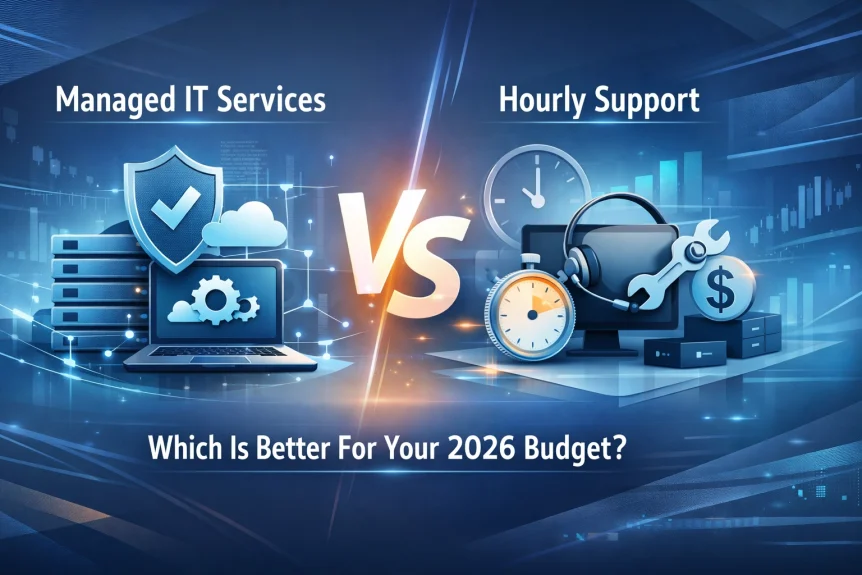
Two primary models: Hourly Support and Managed IT Services.
Decision impacts uptime, security, and scalability for small to medium-sized businesses.
Hourly Support (Break-Fix)
Model operates on a reactive basis.
Services are provided when systems fail.
Billing is calculated by the hour.
Cost Structure
No recurring monthly commitment.
Initial expenditures are minimal.
Emergency rates are applied for urgent repairs.
Costs fluctuate significantly based on hardware failure rates.
Unforeseen outages create budget spikes.
Operational Limitations
Technician availability is not guaranteed.
Response times vary by current vendor workload.
Resolution takes longer due to lack of environment familiarity.
Maintenance is often deferred until failure occurs.
Suitability
Small businesses with 1-5 employees.
Low technical complexity environments.
Businesses with high tolerance for downtime.
Minimal reliance on digital assets for revenue generation.
Managed IT Services (MSP)
Model operates on a proactive basis.
Fixed monthly subscription covers ongoing management.
Focus remains on prevention rather than repair.
Cost Structure
Predictable monthly expenditure.
Fixed fee covers monitoring, maintenance, and support.
Budgeting for 2026 is streamlined.
Capital expenditures are shifted to operational expenditures.
Includes managed IT services and help desk support.
Proactive Monitoring
Systems are monitored 24/7.
Vulnerabilities are identified before exploitation.
Hardware health is tracked to predict failures.
Software patches are deployed automatically during off-hours.

Performance Guarantees
Service Level Agreements (SLAs) define response times.
Uptime is prioritized.
Dedicated team understands the specific network architecture.
Documentation is maintained continuously.
Financial Comparison: 2026 Projections
Hourly Model Risks
Inflation increases technician hourly rates.
Emergency response fees are trending upward.
Data breach recovery costs for SMBs exceed $100,000.
Downtime costs per hour estimated at $1,500 – $5,000 for medium businesses.
Managed Model Benefits
Volume-based pricing for licenses (Microsoft 365, antivirus).
Reduction in labor-intensive manual fixes.
Long-term strategic planning included.
Prevention of catastrophic data loss events.
Network Security Monitoring
Security threats are evolving in 2026.
AI-powered attacks target SMB vulnerabilities.
Reactive Security (Hourly)
Antivirus updates are performed manually.
Firewall logs are rarely reviewed.
Security patches are applied after a breach is detected.
High risk of ransomware and unauthorized access.
Refer to 7 mistakes businesses make with network security monitoring.
Proactive Security (Managed)
Network security monitoring is continuous.
Intrusion detection systems are utilized.
Multi-factor authentication is enforced across all platforms.
Phishing simulations train employees on risk.
Compliance standards (SOC2, HIPAA) are maintained.

Cloud Migration and Infrastructure
Small businesses are moving away from on-premise servers.
Management of cloud resources requires specialized expertise.
Hourly Cloud Support
Configuration is often suboptimal.
Cloud spending is not monitored for waste.
Security settings may be left at default values.
Migration is handled as a one-time project without follow-up.
Managed Cloud Services
Cloud migration is handled strategically.
Resource usage is optimized to lower monthly bills.
Backup and disaster recovery are integrated into the cloud.
Identity management is centralized.
VOIP and Communication
Legacy phone systems are becoming obsolete.
Modern businesses require integrated VOIP solutions.
Hourly Support for Phones
Fixes are billed per incident.
Call quality issues take longer to diagnose.
Updates to phone software are neglected.
Managed VOIP Support
Voice traffic is prioritized on the network.
Firmware updates are managed remotely.
Moves, adds, and changes are included in the service.
High-quality audio is maintained through QoS settings.

Maintenance Comparison Checklist
| Feature | Hourly Support | Managed IT Services |
|---|---|---|
| Budgeting | Unpredictable / Volatile | Fixed / Predictable |
| Strategy | None / Reactive | Strategic Roadmap |
| Monitoring | User-reported | Automated 24/7 |
| Security | Basic / Afterthought | Advanced / Proactive |
| Backups | Manual / Unverified | Automated / Daily Tests |
| Updates | Occasional | Consistent / Automated |
| Downtime | High potential | Minimized |
Technology Roadmap 2026
Modern businesses require more than just technical support.
Strategic alignment of technology with business goals is necessary.
Business Reviews
Managed services include Quarterly Business Reviews (QBR).
Infrastructure age is tracked.
Budget for replacement is planned years in advance.
Shadow IT is identified and remediated.
Technical Alignment
Software is kept within support lifecycles.
Hardware meets current performance requirements for 2026 applications.
Network capacity is scaled according to headcount.

Hidden Costs of Hourly Support
Lost Productivity
Employees wait for technicians to arrive.
Work stops during technical outages.
Frustration reduces employee retention rates.
Opportunity Cost
Business owners manage IT instead of growth.
Technical debt accumulates over time.
Innovation is stalled by outdated equipment.
Risk Exposure
Lack of consistent backups leads to data loss.
Outdated security leads to legal liability.
Compliance failures result in fines.
The Case for Managed IT Services in 2026
For most SMBs, the Managed model offers superior value.
Prevention is cheaper than remediation.
Uptime is a competitive advantage.
Predictable billing allows for better capital allocation.
Specific details available in the truth about managed IT services.
Implementation Details
Transitioning to Managed Services
Onboarding includes a full network audit.
Documentation of all assets is compiled.
Security gaps are identified and closed immediately.
Standardization of hardware and software is initiated.
Ongoing Operations
Help desk provides immediate assistance for end-users.
Network health is reported monthly.
Security protocols are updated as new threats emerge.
Backup integrity is verified daily.

Contact Information
X-Tek
IT Services for Small and Medium Businesses
815-516-8075
Next Steps
Evaluate current IT spending for the previous fiscal year.
Calculate the total cost of downtime incidents.
Assess current security posture against 2026 threats.
Determine if current IT support meets growth objectives.
Have Questions? Request Business Solutions Information
Service Summary
We provide comprehensive IT management.
Focus remains on network stability and security.
Managed IT services are tailored to SMB requirements.
Proactive network security monitoring prevents breaches.
Cloud migration services ensure business continuity.
VOIP solutions improve communication efficiency.
Contact Information
Business Solutions Information Request:
https://xtekit.com/business-solutions-information-request/
Phone: 815-516-8075
Business Hours: Monday – Friday, 9:00 AM – 5:00 PM Central